ON MY MIND
The last weeks of summer
seventeen paintings from The Whitney collection
went through the Whitney’s collection looking for the last weeks of summer and came out with seventeen paintings. Not one of them is on view.
I
That is not an accusation. A collection of this size has to keep most of itself in the dark—that is arithmetic, not neglect. But I spent years building shows at Crystal Bridges Museum entirely out of work that wasn’t hanging, and the habit never left me. And honestly, it kind of seems right. This time is so overlooked, the last weeks of summer, when people are in transition. So the objects sitting in the dark make more sense than those getting hit with sunlight and views and vibrations from the people around them.
So…the last hard heat. The light going gold instead of yellow. Bodies waiting it out indoors with the AC on. The sky becoming a giant painting, a James Turrell, every evening at 7:45. Seventeen paintings, 1961 to 2021, every one of them alone, on a rack, yet they perfectly articulate what I want to say.
What I did not expect was how much the record itself would say. One was bought off the Whitney’s own wall the same year it was lent. One has hung once in sixty-two years. One was exhibited in 2011 and not formally accessioned until 2024. One is painted from the real estate listing for the artist’s own house.
All of these are on my mind and tell the story of how I feel, in Texas, in the last weeks of summer better than I can write down here.
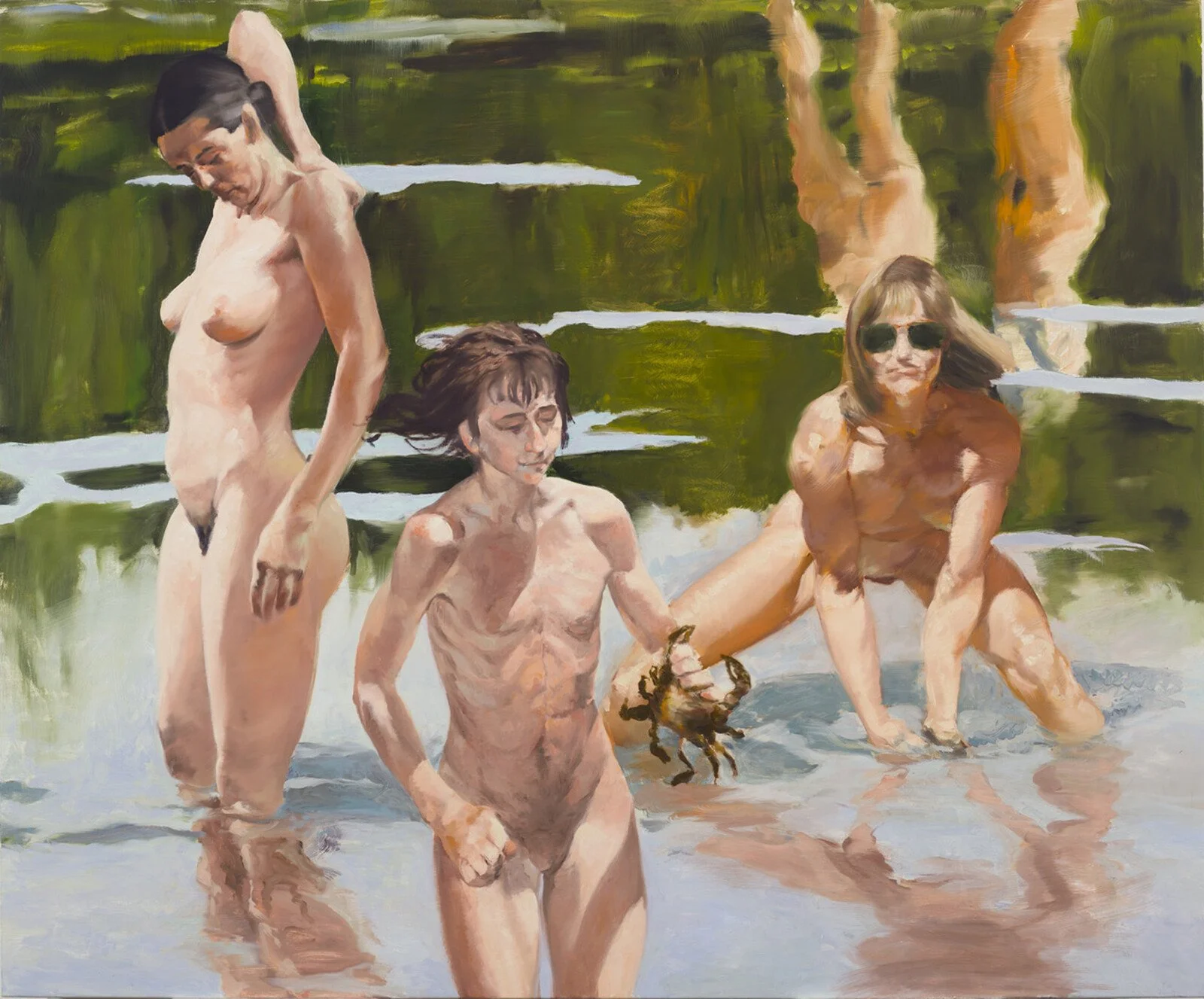
Still hanging on. There’s a part of us that aches for it, that soaks it up before it stops being an option. That’s this.
Eric Fischl, Emptying Out The Estuary, 1993, Oil on linen, 58 1/16 × 70 ¼ in
Fischl grew up on suburban Long Island, went west to Phoenix and then CalArts, and made his name on paintings of American middle-class life that arrive one second before somebody notices. Since 200 he has worked in Sag Harbor, in matching studios with April Gornik.
On his own site this painting sits under Early Beach Paintings, 1980-1996, which is the right file for it. Not the suburban interiors—water, bodies, the shallows, and the particular slackness of a group of people at the end of a long day outdoors.
Its history at the Whitney is the strangest here. Emily Fisher Landau, a trustee from 1987, pledged 367 works to the museum in May 2010; this painting hung in Legacy: The Emily Fisher Landau Collection in the spring of 2011. Then it waited. The accession number is 2024.115—the formal accession came thirteen years after the show. It arrived, was seen, and went back into the dark for over a decade before it was officially the Whitneys’ at all.
Hot boys are summer to me. The faces, the movement of bodies around us, the snapshot of the neighbor over the fence. Katz said he was after the blush int he pale skin. Same thing.
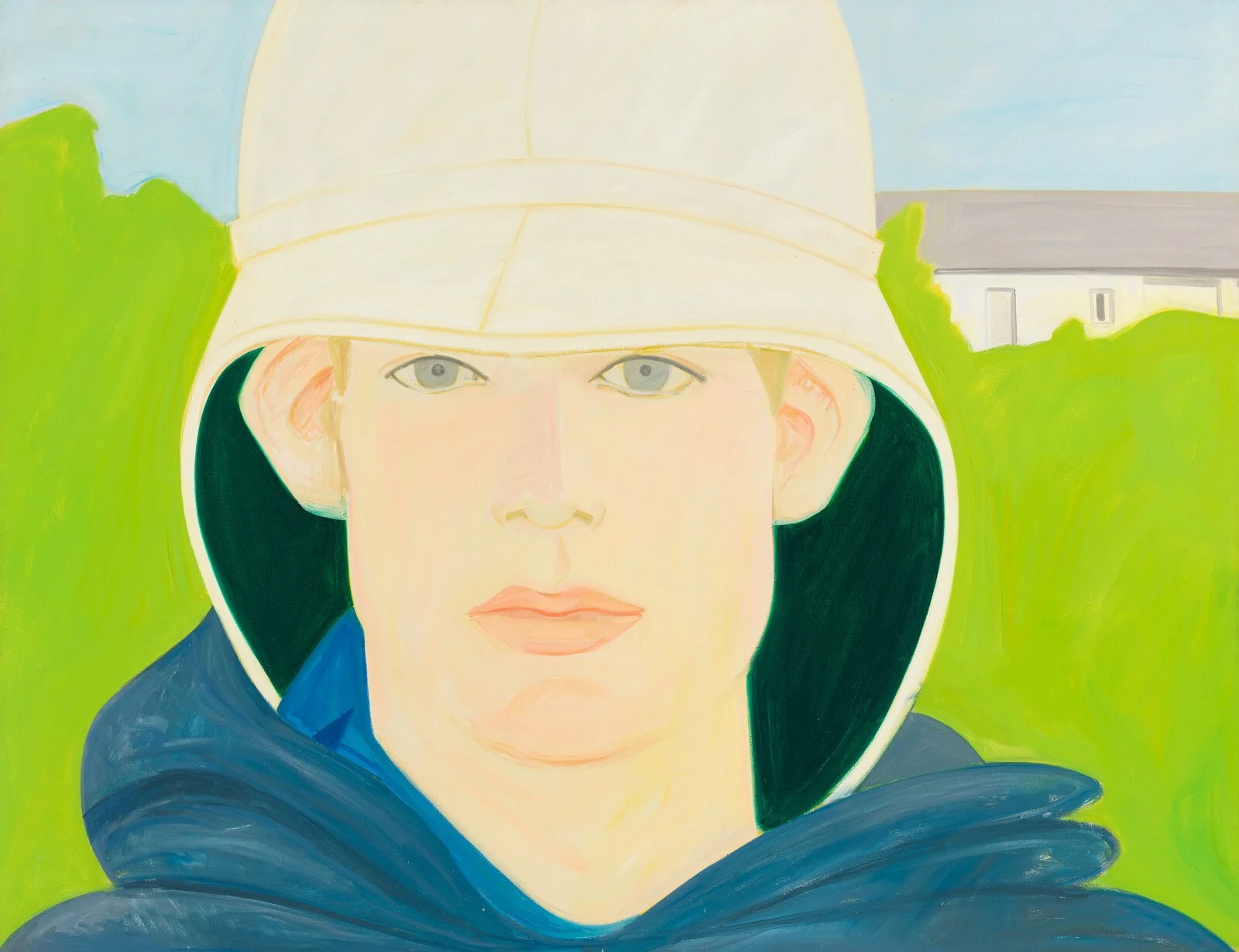
Alex Katz, Eli, 1963, Oil on linen, 75 5/8 × 95 5/16 in.
Katz trained as a graphic designer, and in the early sixties he took the portrait to billboard scale—broad horizontal format, hard cropping, paint laid on smooth and nearly commercial. Eli is the son of Lois Dodd, who had shared a gallery show with Katz in 1953. The Whitney records that Katz was “particularly taken with Eli’s ‘English complexion,’ the faint blush of his pale skin.”
There is no interior life on offer. No place, no hour, no story. Flat unmodulated color in a shallow space, closer to illustration and fashion photography than to portraiture—which is the argument, not a shortfall.
And then the fact that stopped me. Mr. and Mrs. Harbert Fischbach gave it to the Whitney in 1964, the year after it was painted. The museum holds eighty-three works by Katz. In the sixty-two years since, this one has been on the wall exactly once, in De Kooning to Today, 2002-2003.
The last hard heat meeting moisture. Something coming, and no telling where it goes. Late Summer always sends me back to Inness—the whole subject is atmosphere.
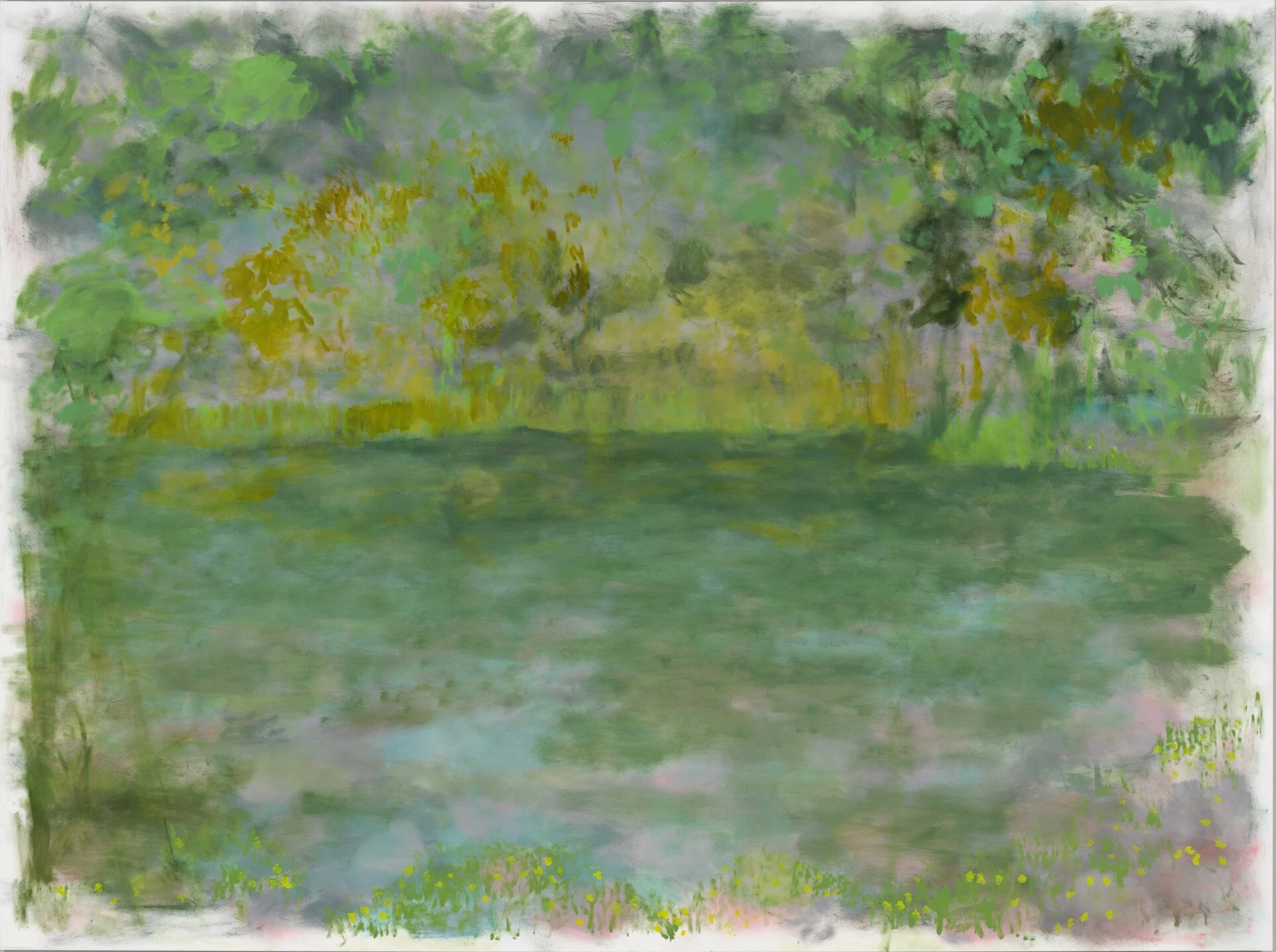
Trevor Shimizu, Pond, 2021, oil on canvas, 112 1/8 × 150 ¼ in
Shimizu was born in Santa Rosa in 1978 and works out of Long Island City. He spent years making paintings and videos that put himself forward as a joke—the Whitney’s own bio calls it “self-presentation, often in humor and self-effacing ways.” Then the landscapes. He paints them from memory rather than from the motif, and the surfaces refuse to be precious: taped-off edges left ragged, stretcher bars showing through, bristles from the brush stuck in the paint.
Pond is nine feet tall and twelve across, and nothing happens in it. The Whitney bought it in 2022 with funds given in honor of Christopher Y. Lew, the curator who co-organized the 2017 Biennial and left the museum that year. It has been out of storage once, for Shifting Landscapes, which closed in January. That is the entire exhibition history.
I keep landing on Inness here, and not for the composition. For the proposition. The air is the picture. Late summer in Texas makes the same argument: you are not looking at a field, you are looking at what stands between you and it.
Summer afternoons when the AC and the smell of the body near you take you into bed. The comfort comes from the one you love.
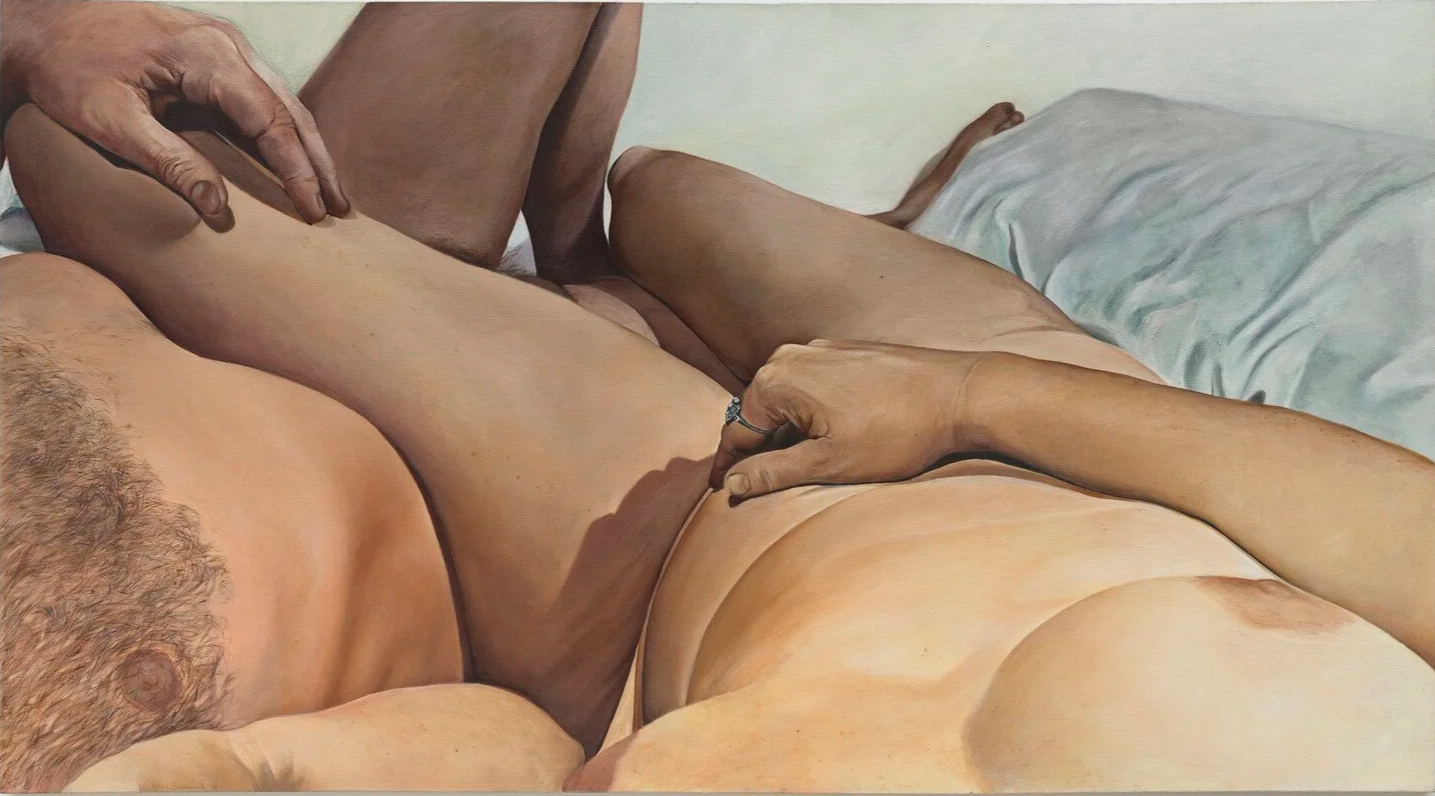
Joan Semmel, Touch, 1975, oil on canvas, 57 1/16 × 103 in
Semmel was born in 1932, came up an Abstract Expressionist, spent seven and a half years in Spain, and returned to New York in 1970 to paint the body from inside her own sightline. For the Self Images pictures she photographed herself first, camera aimed down her own body, the frame starting below the head, and painted from those photographs.
“I took photos of the couple, of myself and a partner, from my own point of view,” she says in the Whitney’s audio. “I was interested in finding an erotic language that would be interesting for women. So for me the whole idea of the touch is very important, and one feels the flesh as the most important part of what’s happening.”
Not everyone agreed at the time. Some feminists held that sexually explicit imagery objectifies regardless of who makes it. Semmel joined Fight Censorship, the group Anita Steckel founded in 1973.
It is a promised gift from Jeff and Leslie Fischer and has been shown at the Whitney once, in Human Interest, 2016-17. Strictly speaking the museum does not own it yet.
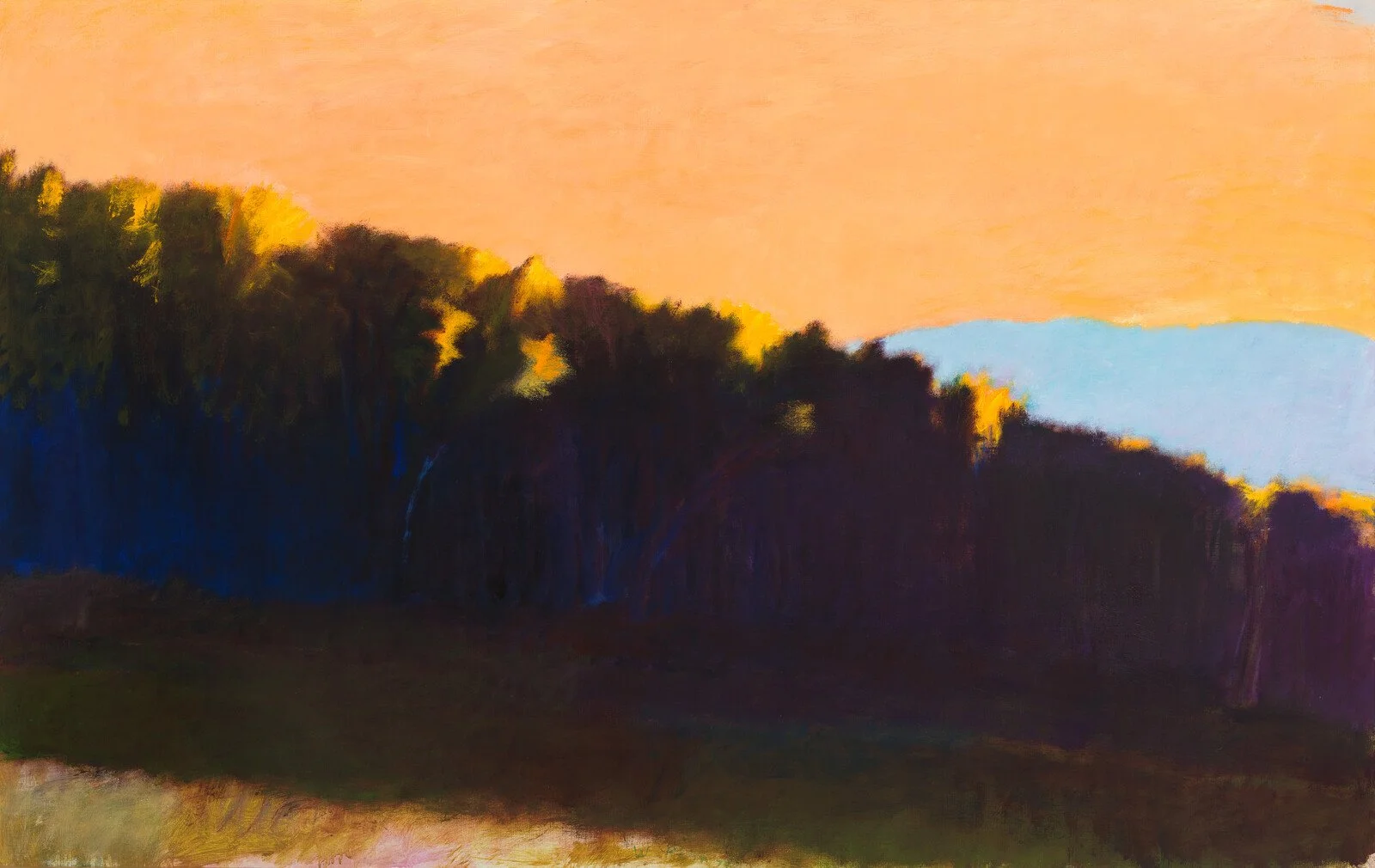
End of summer sunsets have something in them. A perfect mix of warm and cool. It’s the shift, happening above us.
Kahn was born in Hamburg in 1927 and put on a train out of Germany at eleven, in 1939. He reached New York, studied with Hans Hofman and became his studio assistant, and in the late sixties bought a place outside Brattleboro with his wife, the painter Emily Mason. He died in 2020.
His stated ambition was “to do Rothko again, after nature.” Which sounds like a joke about color fields until you look at this—a treelike reduced to a single black shape under an orange that has not quit. “I’m trying very hard not to be arbitrary,” he said. “I think the more daring you are as a colorist the less right you have to be arbitrary.”
Mr. and Mrs. Harry Kahn gave it to the Whitney in 1977. Seven Kahns in the collection; his recorded Whitney Annuals are 1957 and 1961, both long before this was painted. No record of it on a wall.
Wolf Kahn, After Glow, 1974, Oil on linen, 41 ½ x 66 in
This is Texas the last week. This is what it looks like every day at 7:45.
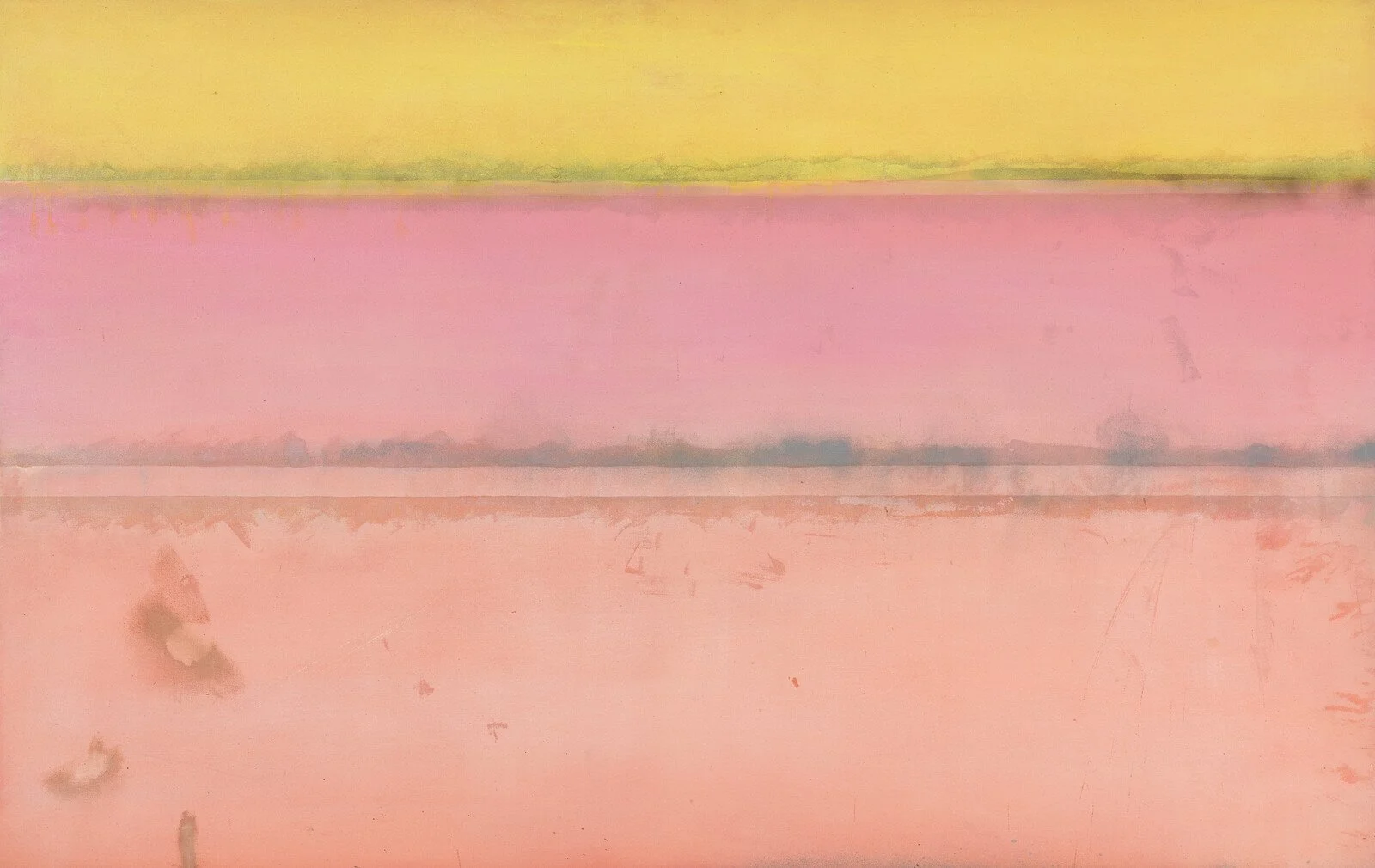
Frank Bowling, Advice and Concent, 1972-1973, Acrylic on canvas, 57 1/8 × 90 in
The poured paintings, made on a tilting platform, paint dropped from as much as two meters, begin in 1973 and run to 1978. Advice and Concent is 1972-73: the hinge. The cartography has dissolved and the pouring has not yet hardened into a system. Three wide bands, yellow into pink into peach.
Born in British Guiana in 1934, Royal College of Art alongside Hockney and Kitaj, London to New York in 1966. “After leaving London to live in New York,” he told the Whitney, “I broke loose and began to get much more involved in pure painting.” He titles paintings after they are finished, which is worth knowing before anyone builds a reading on advice and consent—the play is real, the spelling is his.
The Whitney gave Bowling his first solo museum exhibition in 1971, six large map paintings. Its own artist page does not list it. It bought this painting in 1973 and has no record of showing it since.
The end of August. Trying to keep it going and stay sane while it’s this hot and everyone is still on their own schedule. It’s how I feel writing this. Put me to bed.
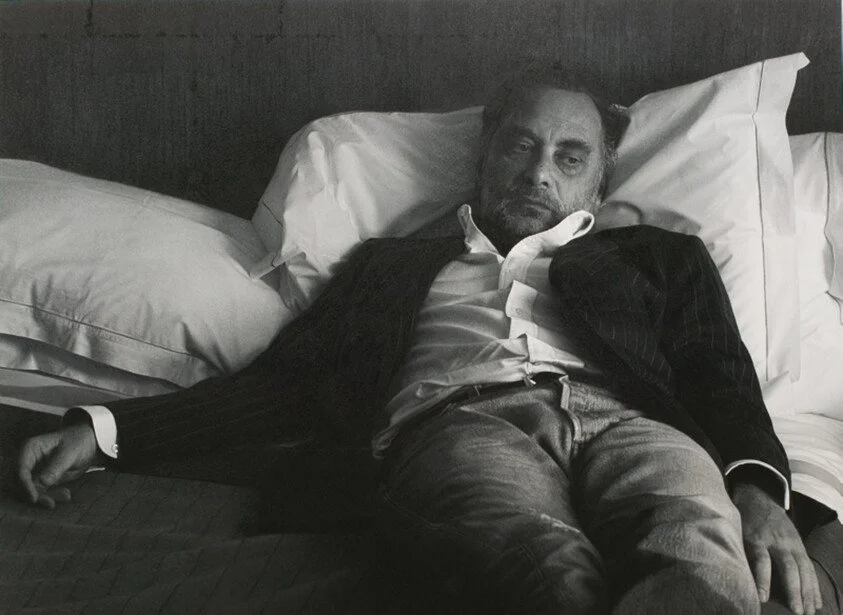
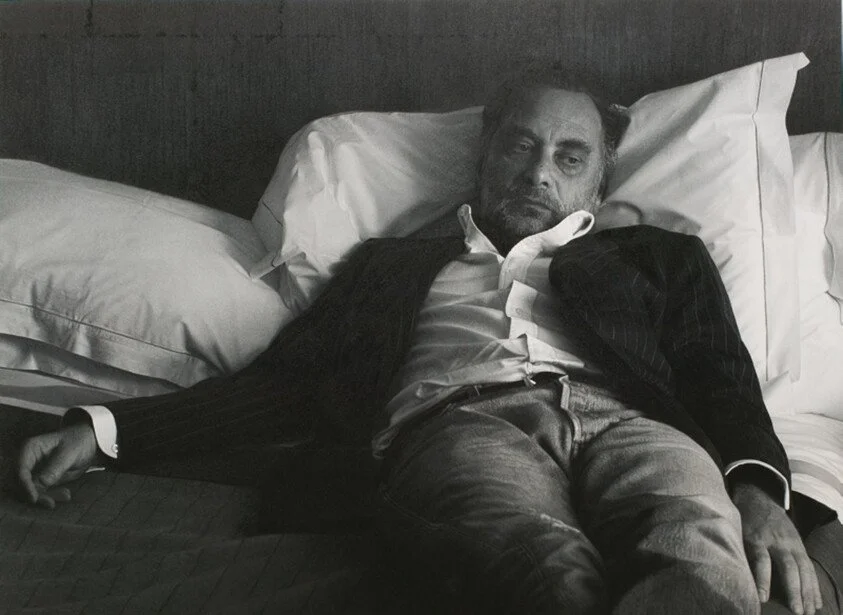
Rudolf Stingel, Untitled (After Sam), 2005-2006, oil on canvas, 139 ½ x 188 in
In 1989 Stingel published an instruction manual for making an abstract painting and then spent roughly a decade following his own rules. That is the practice this picture ruptures. From 2005 he worked photorealistically from photographs shot by other artists—here, black and white pictures of himself taken by Sam Samore, whose name is in the title.
The Whitney describes the work in relation to the rest of his practice well. The earlier footprint and graffiti canvases were “an index of the artist’s physical body”; here the subject moves “from the materiality of painting to the psychological material of the painter.” He is slumped on a bed, still in the suit. The museum calls the pose and the expression a possible “moment of creative crisis,” and notes that he manages to be “larger than life, contemplative, and even vulnerable” at once.
Twelve feet by nearly sixteen. The museum’s record puts it in the 2006 Biennial, Day for Night, and it was bought that same year. It came out again for Human Interest in 2016-17, and has been down since.
The heat sends us to bed early. The heat makes us want. The night calls for wildness and action and the hope that the love of your life is at the other end of a Grindr message. Nobody leaves the room. It goes nowhere, and summer ends.
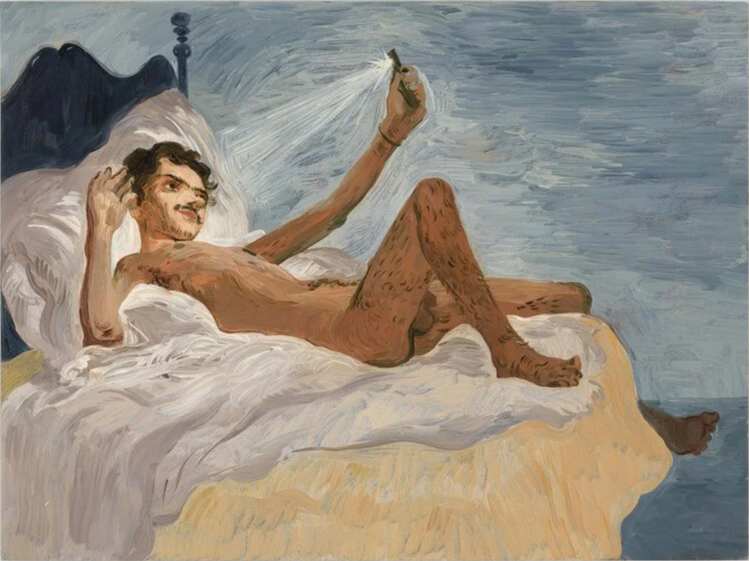
Salman Toor, Bedroom Boy, 2019, Oil on wood, 11 15/16 × 16 in
Twelve inches by sixteen, oil on wood—by a wide margin the smallest thing here, and the intimacy is structural rather than atmospheric. Toor was born in Lahore in 1983, became a US citizen in 2019, and paints imagined young South Asian queer men in rooms.
The Whitney’s own curator, Ambika Trasi, reads it as a young man “taking a nude selfie or perhaps video chatting with a lvoer via his phone in a staged scene of self-celebration and seduction,” his gaze into the camera recalling Man
We’re more aware of the outside in summer. We notice the most subtle shifts. The color, the environment, the place—I feel all of it.
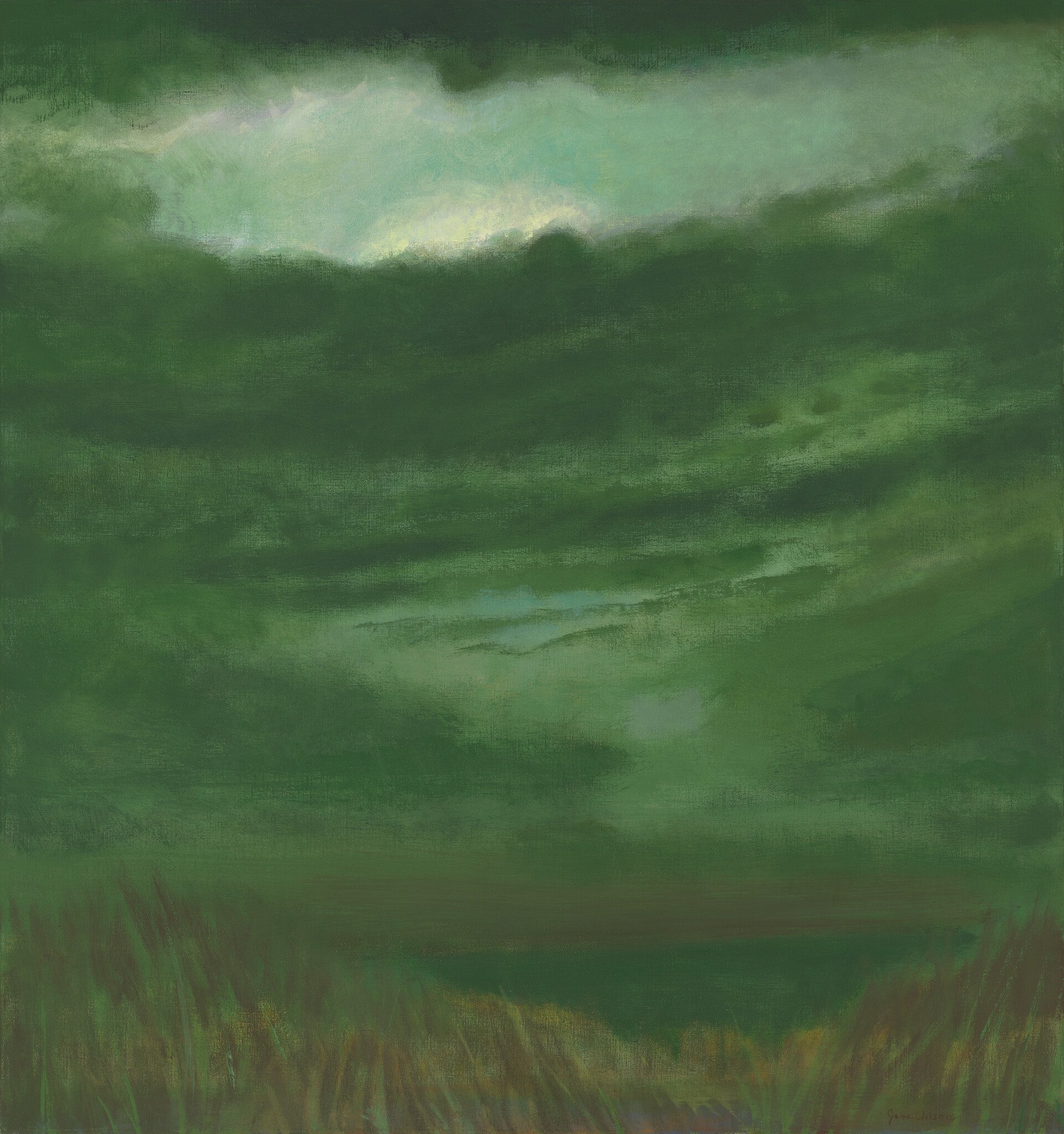
Jane Wilson, Descending Moon, 1991, Oil on linen, 48 × 45 in
Wilson was born in 1924 near Seymour, Iowa, on a family farm, took two degrees at the University of Iowa, came to New York in 1948, and from 1960 kept a studio in an old carriage house in Water Mill on Long Island. She taught at Parsons and then at Columbia. She died in 2015 at ninety.
“Growing up on a farm,” she said, “you lived at the bottom of a sea of weather.” And: “What I'm aiming for are moments of strong sensation — moments of total physical experience of the landscape, when weather just reaches out and sucks you in.”
She painted thin and dry and scumbled, working into the surface rather than onto it, so the light seems to come from behind the paint instead of off it. Descending Moon belongs to a run of early-nineties skies — Eclipse the same year, Moon in Transit the year before.
It came to the Whitney in 2017 by her own bequest. Fifteen Wilsons in the collection, her Annuals are 1961, 1965 and 1967, and this one has not been shown.
The light is different now. The buildings are holding the day's heat. The brushstroke, the color, the monumentality — it's the feeling of right now.
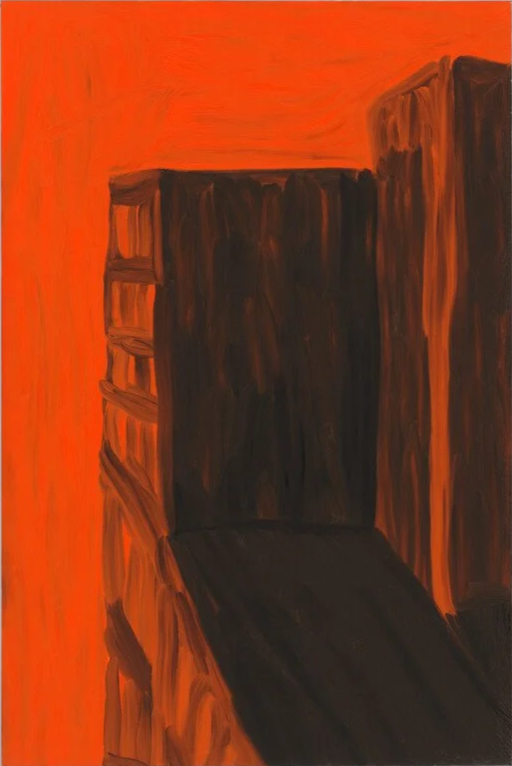
Martha Diamond, Orange Light, 1983, Oil on linen, 84 × 56 in
Diamond moved into a Bowery studio in 1969 and stayed fifty-four years, until her death in 2023. She painted the city from memory — not from the window, not from photographs — working alla prima with her non-dominant left hand, wet into wet, starting ideas small on board before taking them up in scale.
“I'm more concerned with a vision than expressionism,” she wrote in 1989, “and try to paint that vision realistically.” And: “I know the city has straight lines or edges but as I walk around the ending or beginning of substance becomes less absolute.” That is precisely what seven feet of orange and black is doing here — an architecture you would recognize and could not measure.
It came to the Whitney in 2023 as a gift of the Alex Katz Foundation, which is why his name sits under the picture and misleads people. It is hers. The museum first acquired her work in 1976 and holds four; she was in the 1989 Biennial. There is no record of this painting being shown.

Heat. Two people pushed into silence—comfortable, but silent. Both of them gasping for the relief of fall.
Philip Pearlstein, Female Model on Adirondacks Rocker, Male model on Floor, 1980, Oil on linen, 72 × 72 in
Pearlstein painted from props he hauled in off the street. He was a compulsive collector — flea markets, antiques dealers, sidewalks, later eBay — and the objects went straight into the pictures, chosen for visual rather than symbolic effect. The chair in the title is doing exactly as much work as the people in it. “The setups I produce in my studio are really theatre designs,” he said. “Maybe that's what I should be exhibiting.”
The cropping is a rule, not an effect: “I start in the centre of the canvas. What is missing around the edges of the canvas is someone else's problem.”
Six feet square. The Whitney bought it in 1980 with Painting and Sculpture Committee funds and Friends of the Whitney funds by exchange — which means it was paid for in part by selling something else. The museum holds nineteen Pearlsteins, and he was in ten Whitney Annuals and Biennials between 1955 and 1991. This painting was in none of them, and there is no record of it hanging since.
It’s the light. Everyone tanned and strong, sweat and sunscreen, the last gasps of movement. Summer is normal by now, but the angle has shifted—more gold than yellow. The change isn’t here yet and we already know. So we hang on and hold it.

Rackstraw Downes, The Tennis Courts in Riverside Park at 119th Street, 1978-1980, Oil on canvas, 18 ¾ x 46 3/8 in
Downes was born in Kent in 1939, read English at Cambridge, took an MFA at Yale under Neil Welliver, Al Held and Alex Katz, and turned from abstraction to observation in 1966. He has never worked from photographs. “I like to use my eyes,” he told Phillip Lopate in 2002, “stand out there for weeks on end until I think I've got exactly what I see.” A full-size painting takes him two or three months; he finishes four or five a year. The two-year date on this one is the method, not indecision.
Eighteen and three-quarter inches tall and nearly four feet wide. He has said he isn't especially interested in painting sky, and prefers the wide proportion because he is “interested in what connects to what.”
It hung in the 1981 Whitney Biennial — the catalogue lists it — and the museum's accession number is 81.2, among the first things it took in that year. Since then, nothing on the record.
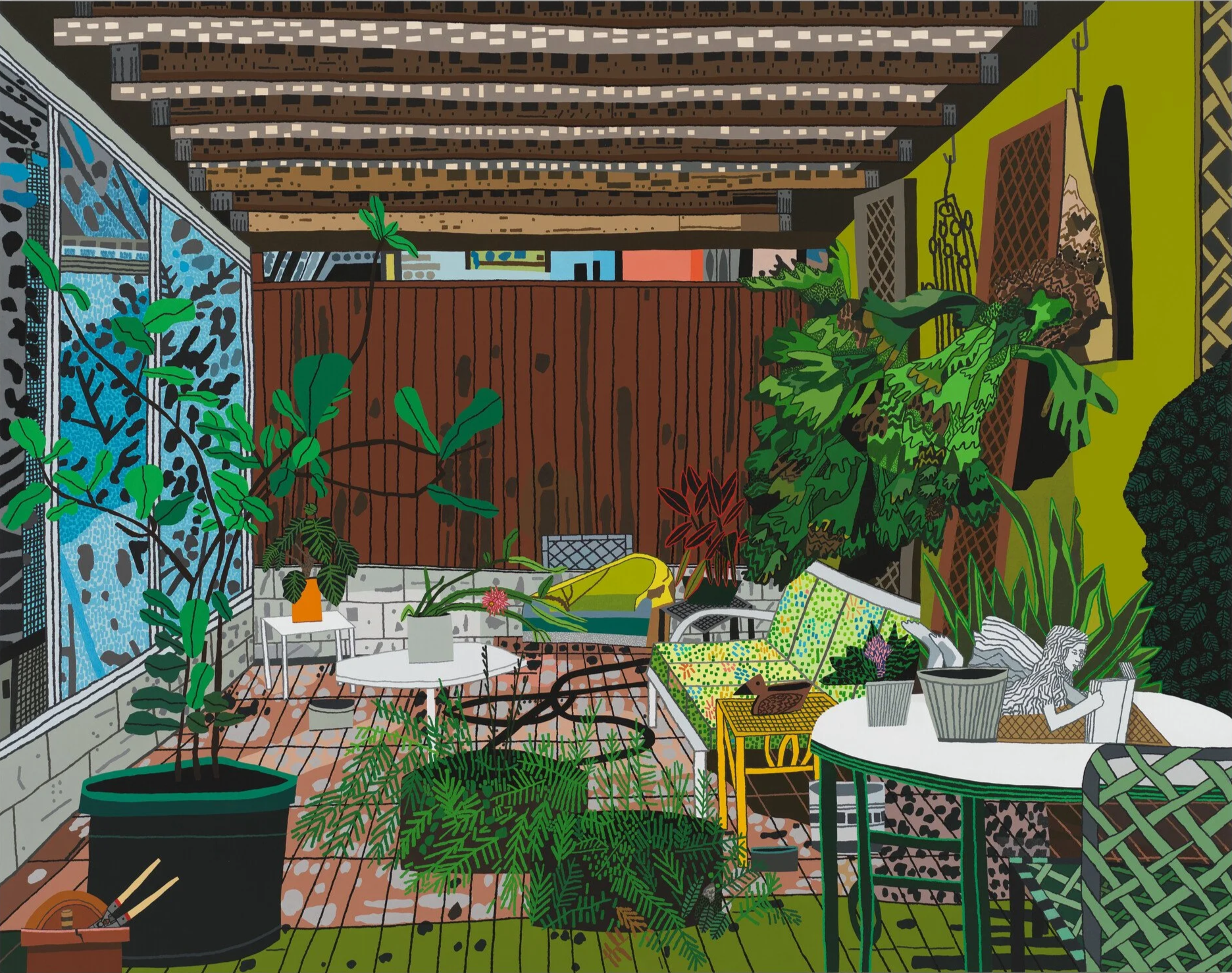
This is my porch. The plants gone huge and thick and heavy, the dust of summer over everything, and I still go out there at 104 degrees. Quiet and protective and beautiful.
Jonas Wood, Inglewood Listing, 2019, Oil and acrylic on canvas, 93 3/16 × 118 1/8 in
The title is not a metaphor. When Gagosian showed the painting in 2019 the gallery said outright where it came from: Wood painted it from a photograph in the original real estate listing for his own house, taken in the early 2010s, before he lived there. The grained timber beams and the foliage are the ones he ended up owning.
That is the part worth sitting with. A picture of a room, made from the picture a stranger shot to sell it — a home at its most public and least inhabited, painted at eight feet by ten by the man who eventually moved in. “I'm interested in observing how somebody else put objects together in a space,” Wood told Hans Ulrich Obrist that same spring. “I put these objects together in my interiors, but the configuration is based on what someone else has assembled.”
The Whitney bought it in 2020 with funds from anonymous donors. Six Woods in the collection. This one has never been on its walls.
This is it. The memory, the romance in the rearview. It’s literally called a backdrop. Let’s paint it up and write the story.
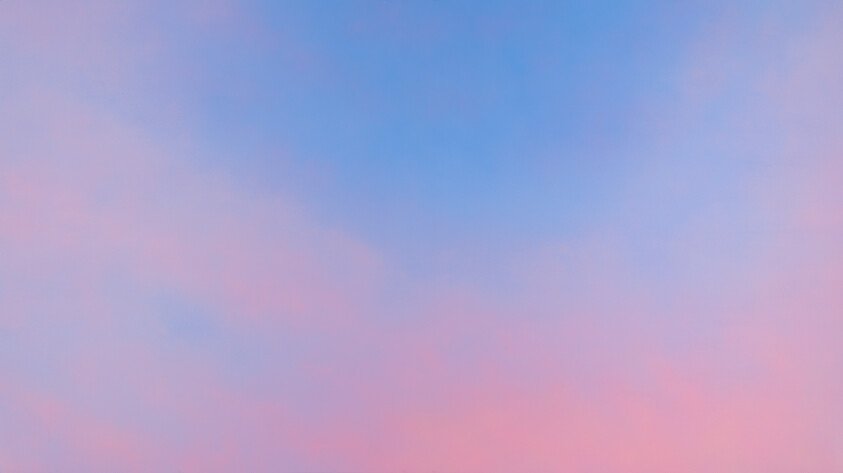
Alex Isreal, Sky Backdrop, 2013, Acrylic on canvas, 108 × 192 in
The title is not a metaphor and neither is the method. Israel's Sky Backdrops are made at Warner Bros. Gagosian stated it flatly in 2014: Sky Backdrop (2013) “is painted by a Warner Bros. scenic artist.” Israel has said the same of the practice — “my works are produced on the Warner Bros. Studio backlot with the assistance of the Scenic Art department.” The Hollywood Reporter went and found the studio's last remaining full-time scenic painter, still on staff.
So: a Los Angeles sunset, nine feet by sixteen, executed by the people who paint skies for movies. Israel: “I wanted to convey the true magic of Southern California, the light and the sky.”
I don't read that as cynical. It may be the most honest thing in the run. The way we hold onto summer is by painting scenery and standing in front of it.
Sascha S. Bauer gave it to the Whitney in 2016. Sky Backdrop is a serial title — MoMA has one, the Broad has one — so be careful which is which. No record of the Whitney's ever being shown.
Summer travel, the road, looking. Now the dreaming has to turn into action—we have to make something of what we learned and dreamt and created. Looking out over the horizon of the dream from the stability of the future.
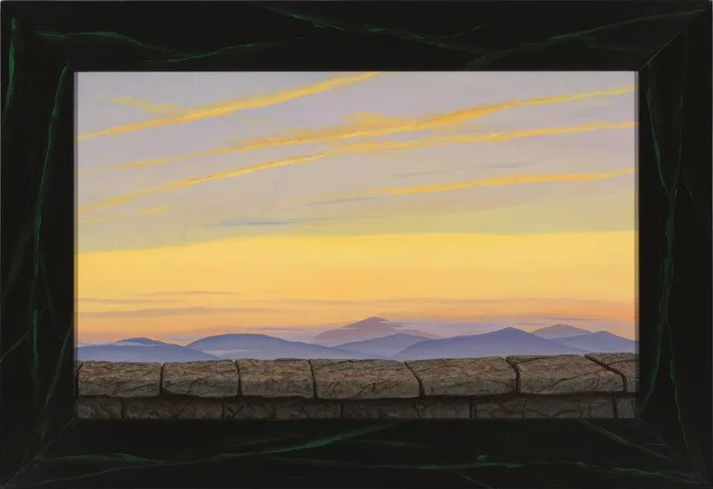
John Beerman, Triumph over Distrust, 1986, Oil on wood and linen with frame, 21 ½ x 31 ¼ in
Beerman was born in Greensboro in 1958, went through RISD and Skowhegan, and spent years in Nyack, in the house that had been Joseph Cornell's childhood home, painting the Hudson. He gets filed with the Luminists, which is fair and slightly beside the point.
The fact I would put on the label is the accession number: 2024.71a-b. The a-b is the painting and the frame. He painted the frame too, so the museum catalogues it as two parts of one object. A twenty-one-by-thirty-one-inch picture that insists on being a whole thing.
“Your imagination is only as good as your observation,” he has said. “Once you stop observing, your imagination becomes cliché.”
It came in with the Emily Fisher Landau gift in 2024 along with one other Beerman. Those two are the only works of his the Whitney holds, and the museum lists no exhibitions for him at all.
A hallucination. A fantasy. A dream of the mind shifting through eclipses. Clear painted east Arkansas from memory, which is exactly what this is. Beautiful, and Arkansas, and it makes me nostalgic.
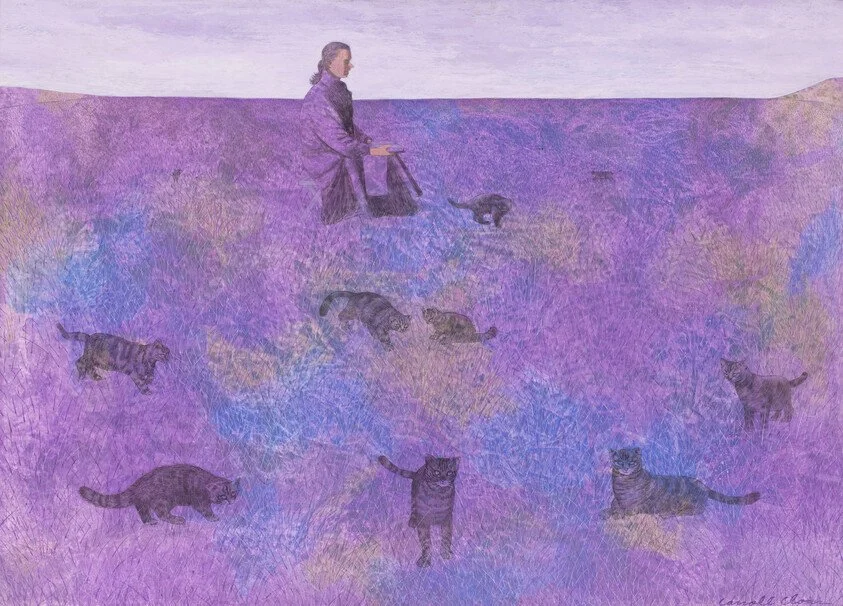
Carroll Cloar, Cat Sanctuary, 1961, Tempera on composition board, 23 1/16 × 31 ¾ in
Cloar was born in 1913 on a farm outside Earle, in Crittenden County, and died in Memphis in 1993 having made more than eight hundred works. Art Students League, a Guggenheim in 1946, Memphis permanently from 1955. He worked in casein tempera on Masonite in these years — the Whitney's “tempera on composition board” is the same thing said drily — and he built pictures out of memory and photographs rather than from life. “American faces, timeless dress and timeless customs,” he said of his subject, “the last of old America that isn't long for this earth.”
The Whitney bought Cat Sanctuary in 1962 with funds from Roy R. Neuberger and his wife. Cloar was in four Whitney Annuals between 1952 and 1961, and it is tempting to assume the museum took this one off the wall of the last of them — the accession number falls inside that show's run. It didn't. The 1961 Annual catalogue lists a different painting entirely, The Mule Herder.
Five Cloars in the collection. No record of this one hanging.
Now we summon it and drive it forward. The year isn’t over. It’s time to make something for ourselves.

Jeffrey Gibson, I Know You Have A Lot of Strength Left, 2017, Rawhide, acrylic, graphite, metal tacks, and canvas on panel, 82 1/8 × 65 1/8 × 2 ¾ in
Rawhide, acrylic, graphite, metal tacks, canvas on panel — nearly seven feet tall and almost three inches deep. A stretched hide studded with driven tacks, not a painted canvas.
“My first love is painting,” Gibson has said, “whether it be on rawhide or on canvas. The rawhide places the viewer and demands that the actual painting be considered from a perspective other than Western or European art histories.”
On the text pieces, which is why this is the right place to stop: “I think with text initially they were messages to myself.” He is Mississippi Choctaw and Cherokee; in 2024 he became the first Indigenous artist given a solo exhibition in the United States pavilion at the Venice Biennale.
It hung in An Incomplete History of Protest from August 2017 to August 2018, and Gibson gave it to the museum the following year. Of the eighteen paintings here, it is the only one whose Whitney exhibition history runs to a full sentence — and the only one that says something back to you.