CHANDLER
the interviews
It’s Just Us Everywhere: A Conversation with Jordan Artim
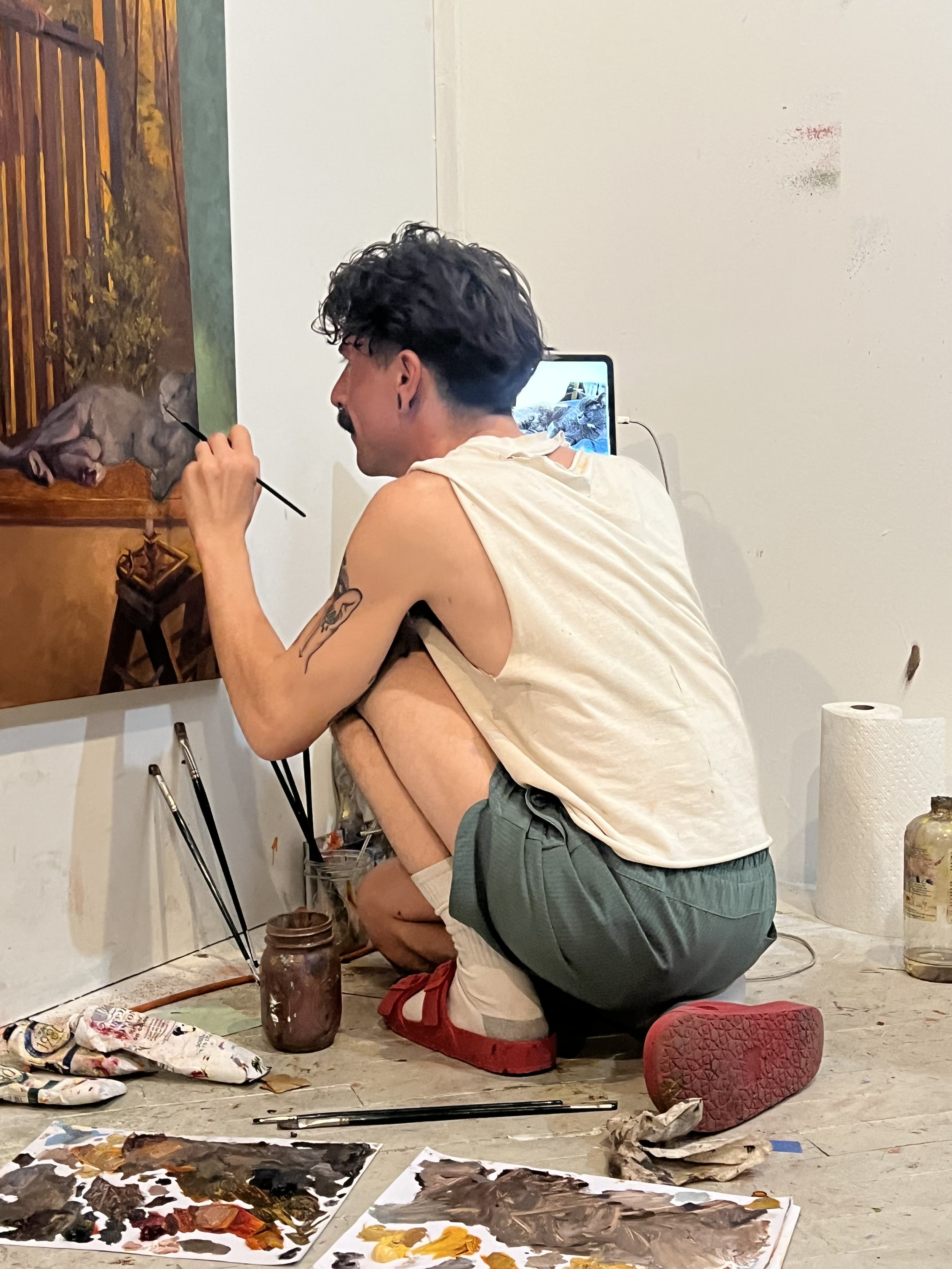
Painting is where he comes alive. The studio, a mystery to anyone who isn’t in it, is where he has to be his truest self. It’s where his unexplainable love affair with paint can be explored and experimented with, safely.
by Dylan Chandler Turk
November 11, 2026
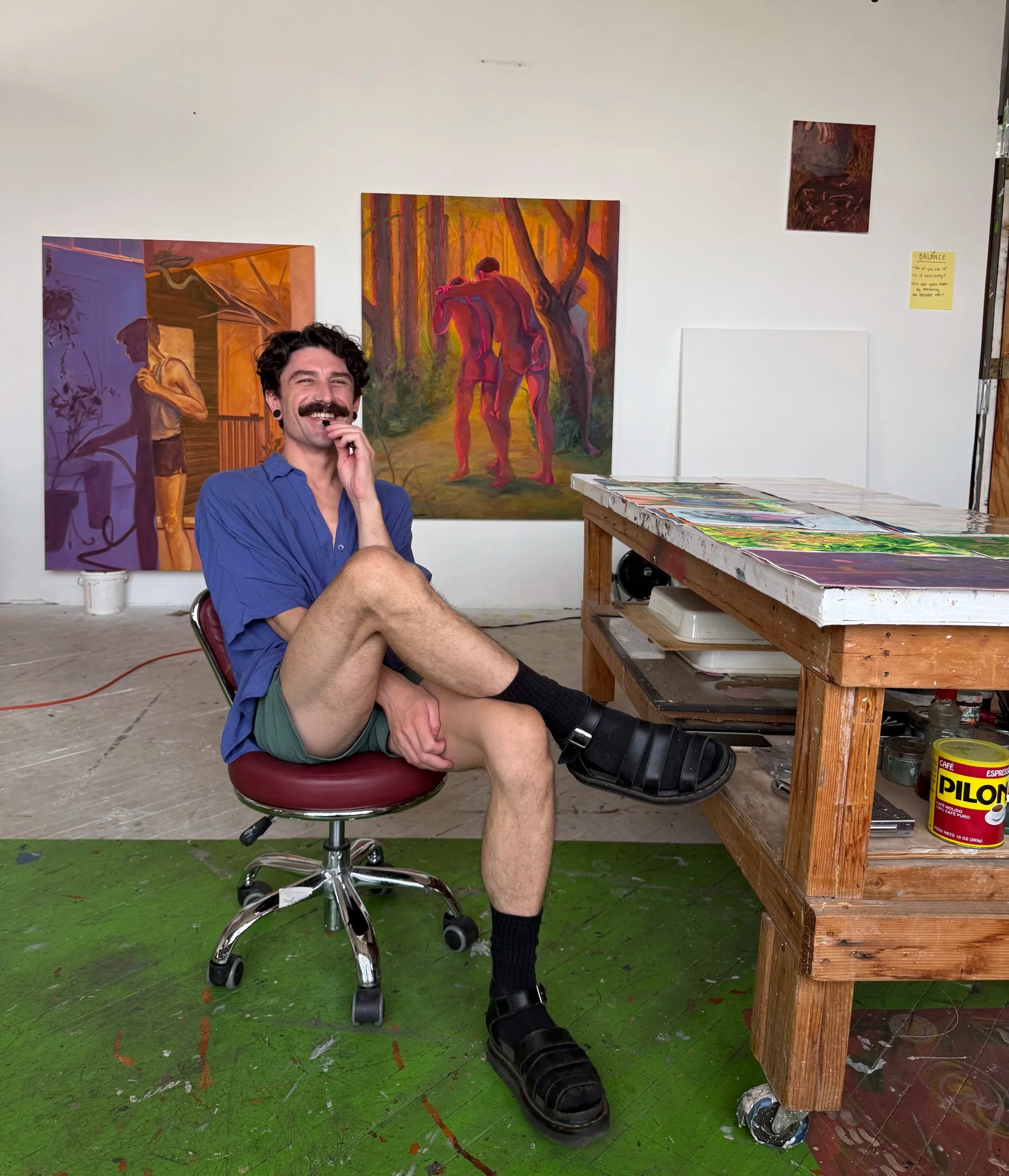
Jordan Artim's care comes through in his voice. I can hear him weighing which word to use, how to deliver it. It isn't hesitation. It’s clarity. How things come together, how things fall, what you say about someone you love. It matters to him deeply.
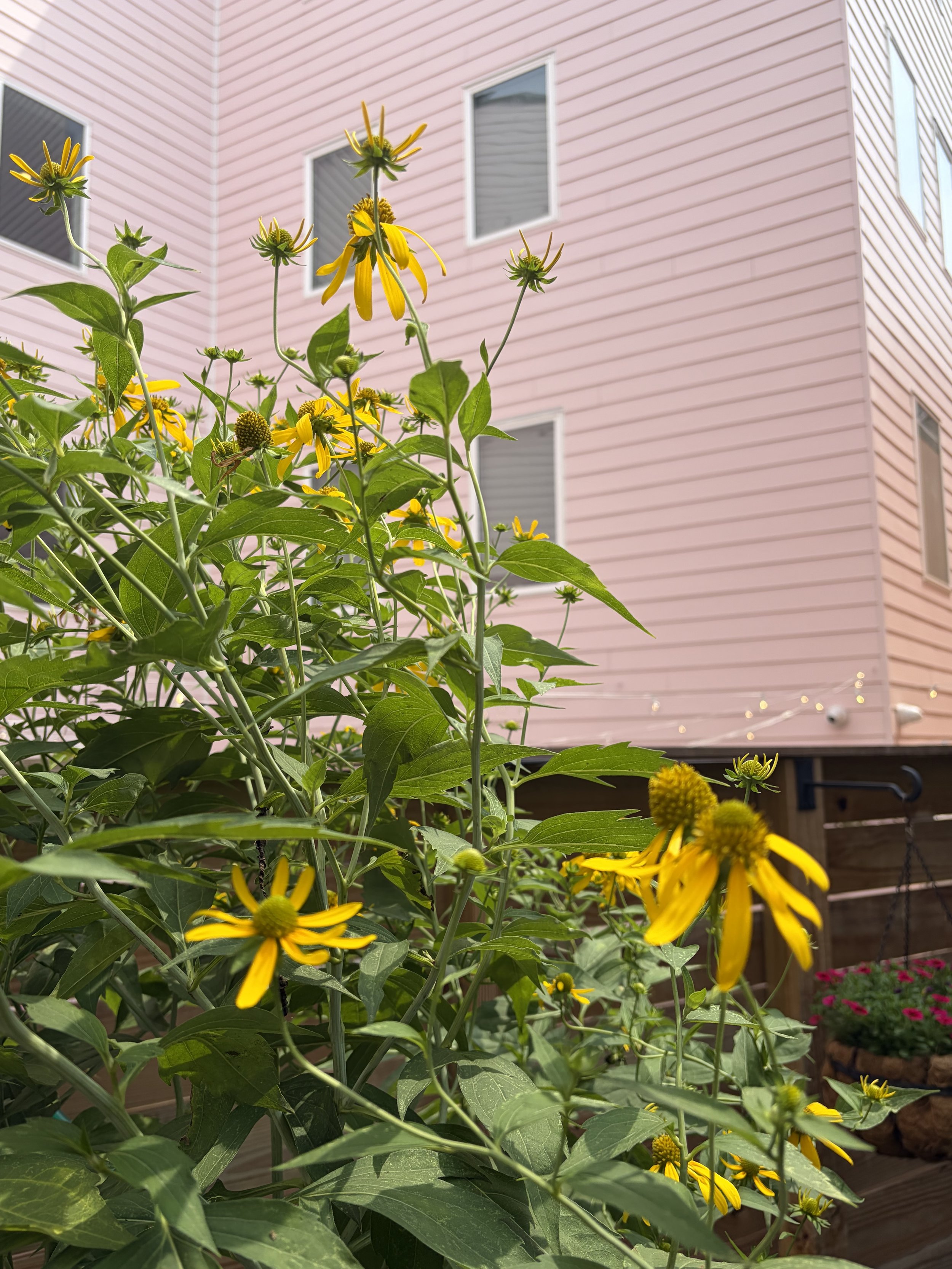
In Sweat, Jordan’s husband, Mitch, stands against a cluster of cutleaf coneflowers, shovel planted, lifting his shirt to wipe his face, the light pouring in behind him. When Jordan talks about painting him, wanting to pull light around him, the biblical halo of it, I wish someone felt that way about me. To be someone’s muse like that feels otherworldly. Through his craft he can refine and refine, layer and study, and make something that articulates a feeling better than anything else could.
There are moments when I feel the rush, the water falling over him, because he loves what he does and he gets to talk about it only a little. There's so much he wants to say, a fecund garden that feeds him, and words narrow it. I feel him slowing himself down to decide how to tell me. About the joy, the high of forming an idea, articulating it, executing it. That's art, I guess.
So often, in education, interpretation, media, captions, it's all about the subject matter. The surface. I understand why. The surface is what we see without questions, without looking, without empathy and acknowledgment of our own humanness. It's easy. But Jordan showed me that the subject is a vessel. It's the thing he gets to place his art inside of. And by art I don't mean the finished piece. I mean the intellectual, emotional, and almost mythical things that tumble around to make the painting. Language has no single word that describes that.
In the studio, he’s refining, experimenting, learning his medium and himself. Technical excellence and human flaw, held in balance. That’s where he comes alive. Imagine a world full of people who had come alive.
We like to talk about artists as people who have arrived, who've reached the prophetic point of using their gifts to express something true. In reality they're on the same journey we are.
There are notes all over Jordan’s studio pushing him. Reminding him not to get comfortable. To ask, every time, if this is the right way. That comes from a lived knowing that things change. We change. We must. With every painting he learns something that expands his understanding of who he is.
He's genuine, and sweet, and tender, and so thoughtful. He's getting somewhere really beautiful.
Jordan Artim was born in Bethlehem, Pennsylvania, in 1990. He studied painting at the Tyler School of Art in Philadelphia, took his MFA at Hunter College in New York in 2018, and came back to Philadelphia, where he paints six days a week. His solo show Loop of a Stem, curated by Chrissy Scolaro, opened at Maiden Lane Gallery in Kingston, New York, this September. We talked a few days after the opening. Sweat, the painting we kept coming back to, is now out in the world for the first time. Jordan is one of three artists featured in the William Way LGBT Community Center's 20th Annual Group Art Exhibition, selected by Stamatina Gregory of the Leslie-Lohman Museum. It's at Huddle in Northern Liberties, Philadelphia, through December 5. He first showed at William Way in 2013, the year he finished at Tyler.
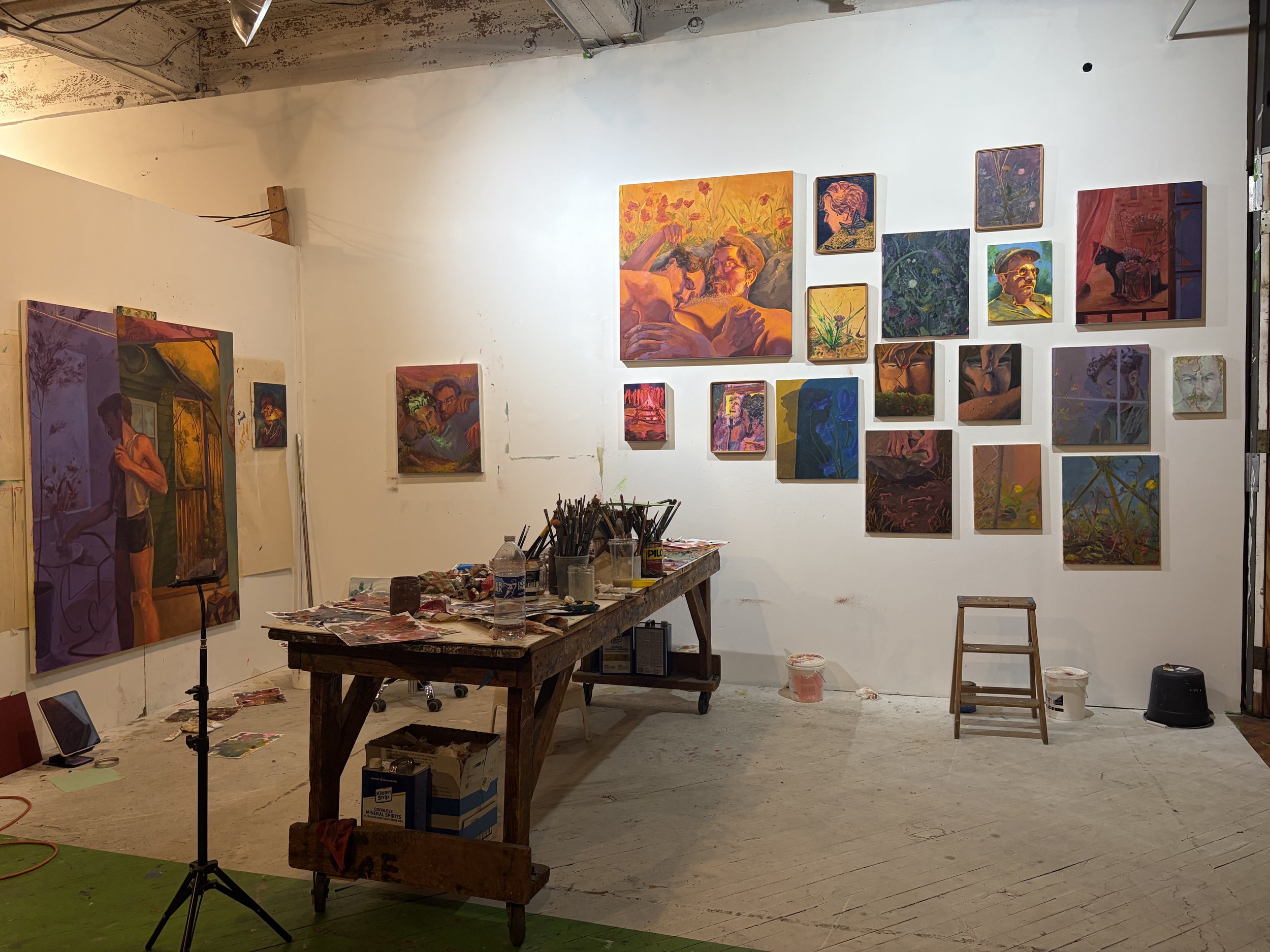
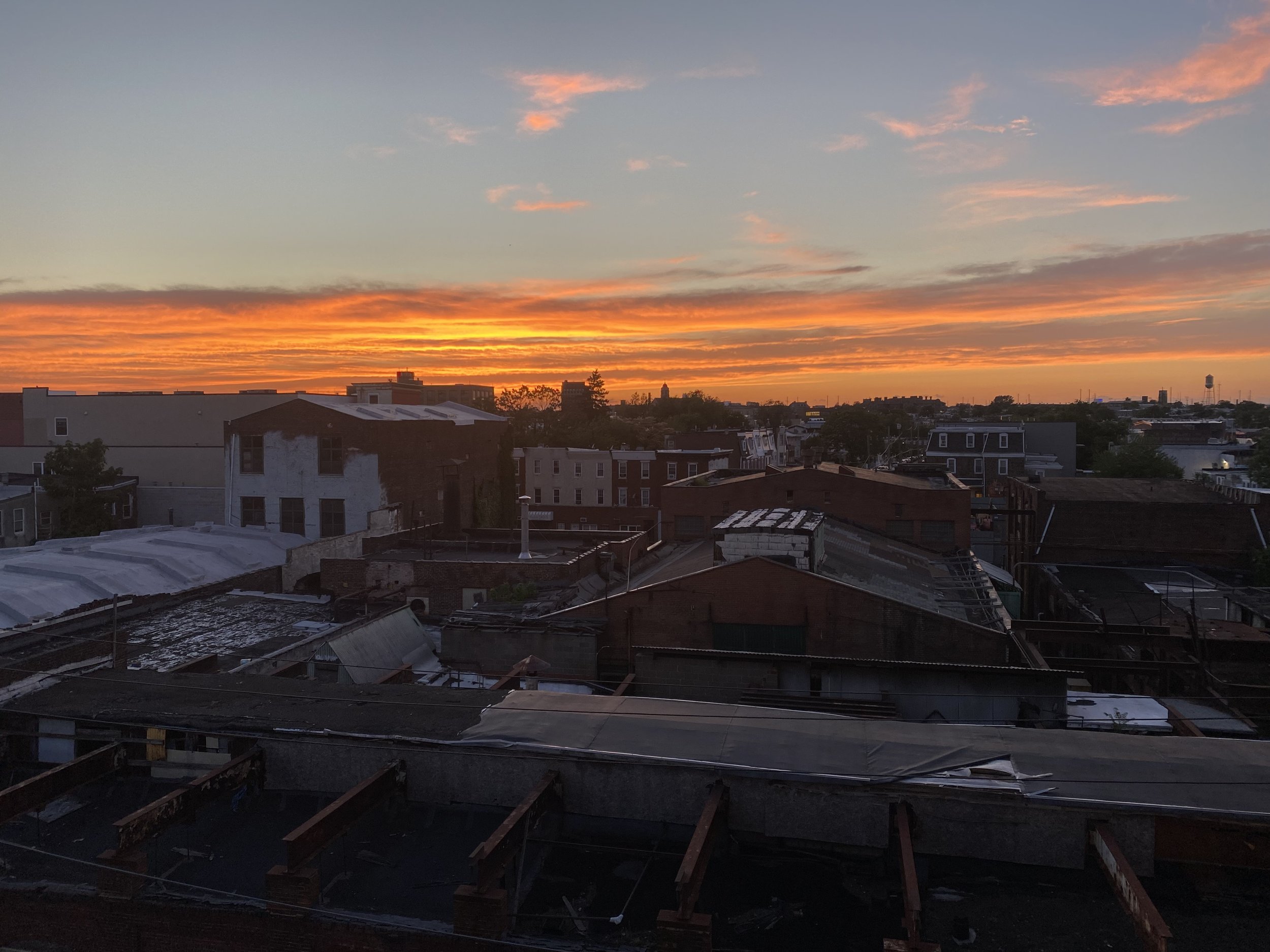
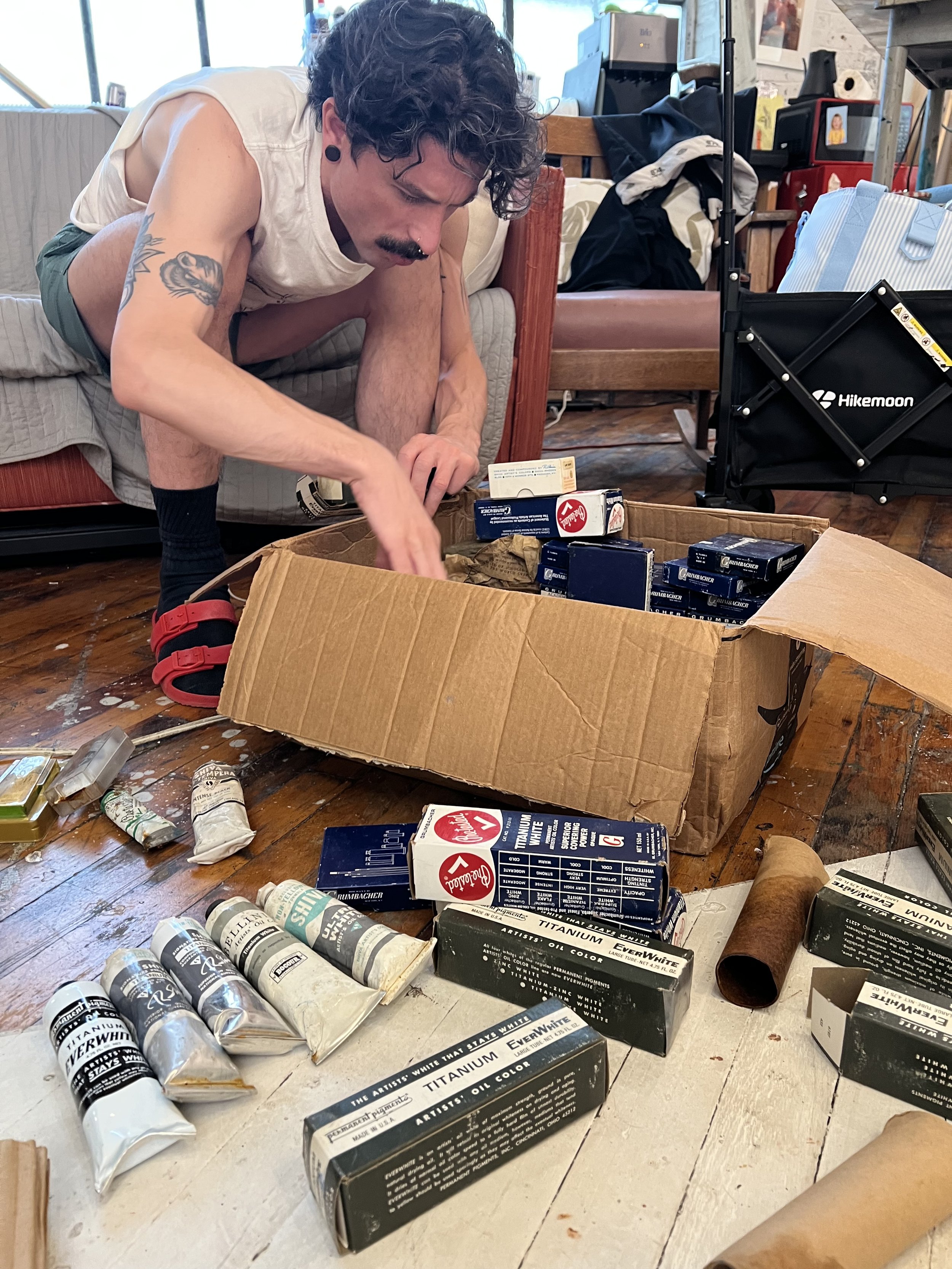
I ask everyone I interview for photographs from their own life around the time we talk.
TURK: Congratulations on the show. You're a few days out from the opening. At 22, you said painting was everything. Is it still? What does painting mean to you, and why do you do it?
ARTIM: The short answer is yes, it still is, for sure. It's the place where I feel the most excited, where my brain is pumping at the highest frequency. I get so much satisfaction, but also so much thrill out of it. There's a difference between making art and painting. I think about painting as a craft, the act of making an image. That's what I mean by painting is everything.
TURK: When's the first time you remember thinking, wow, painting is something?
ARTIM: Definitely high school. I was always drawing as a kid, and I really liked art. I grew up with two siblings. I have six now. But they were very sports-minded, and art and crafting was always the thing I was interested in. In high school it really dawned on me. You start having conversations about what you want to go to college for, what you're going to do with the rest of your life, and that was the only thing that made sense to me. It was the only option I could see.
TURK: Looking at your work, I feel like you've had a transformation over the last few years. A shift in your painting. Would you agree?
ARTIM: I don’t know if I consider it to be. It definitely is a shift, and there is a transformation that happened. I was feeling really displaced over the last couple of years. Mentally, and with my own studio practice. And over the last year or two is when everything kind of shook into place, and I started to feel like myself again.
TURK: Was the displacement in you as a person, and it rippled into the studio? Or the other way around? Or are they one and the same?
ARTIM: When it's good, they're one and the same. And when it's bad, I can feel it. That's what the displacement is. When it isn't the same is when things go really bad.
TURK: Is the studio a refuge?
ARTIM: Yeah. I can come into the studio and it's the act of painting. I want to teach myself how to use dioxazine purple today. Or I want to figure out how to paint a cloud of cigarette smoke. It's these tasks, in a way, that remove me from whatever else is happening.
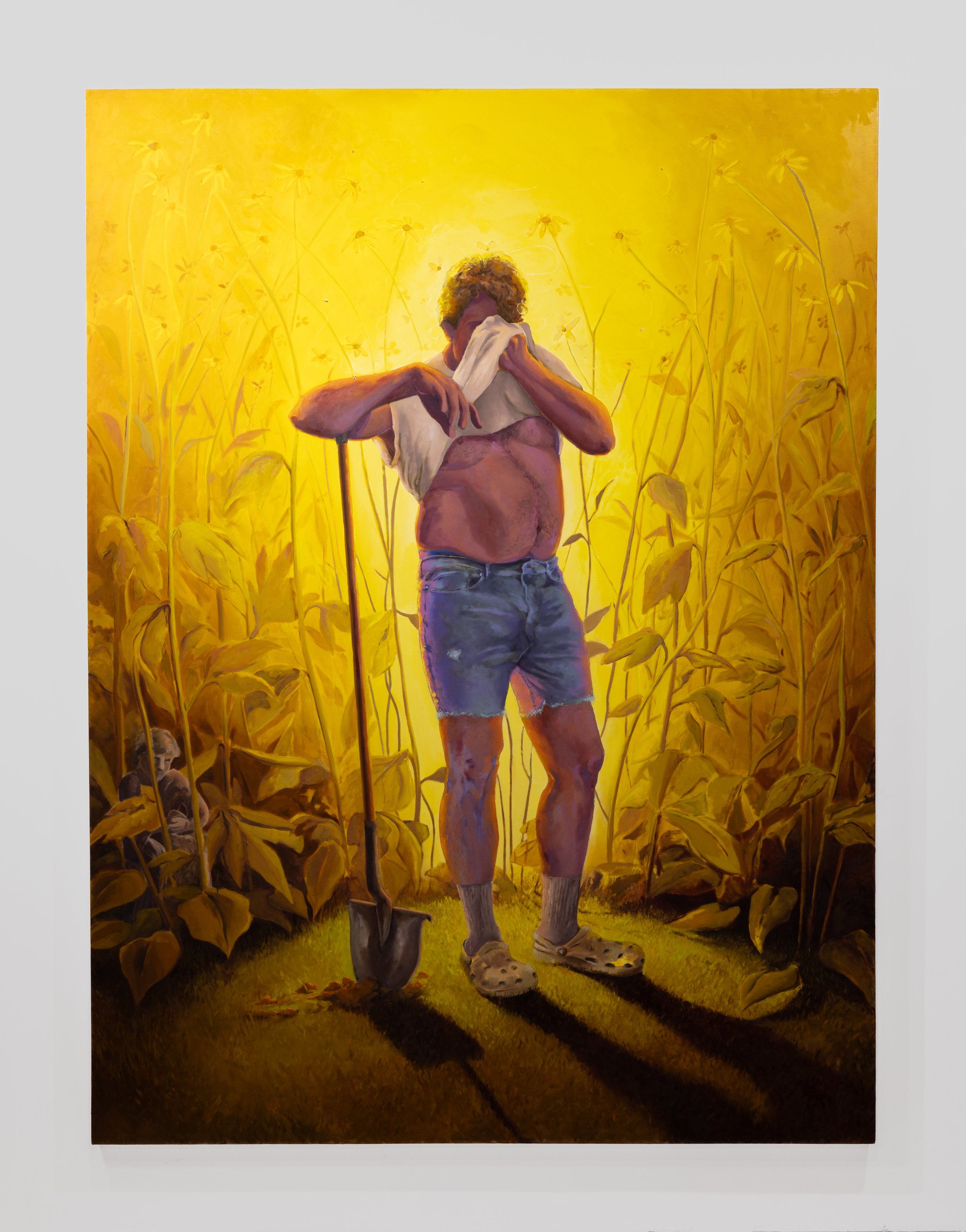
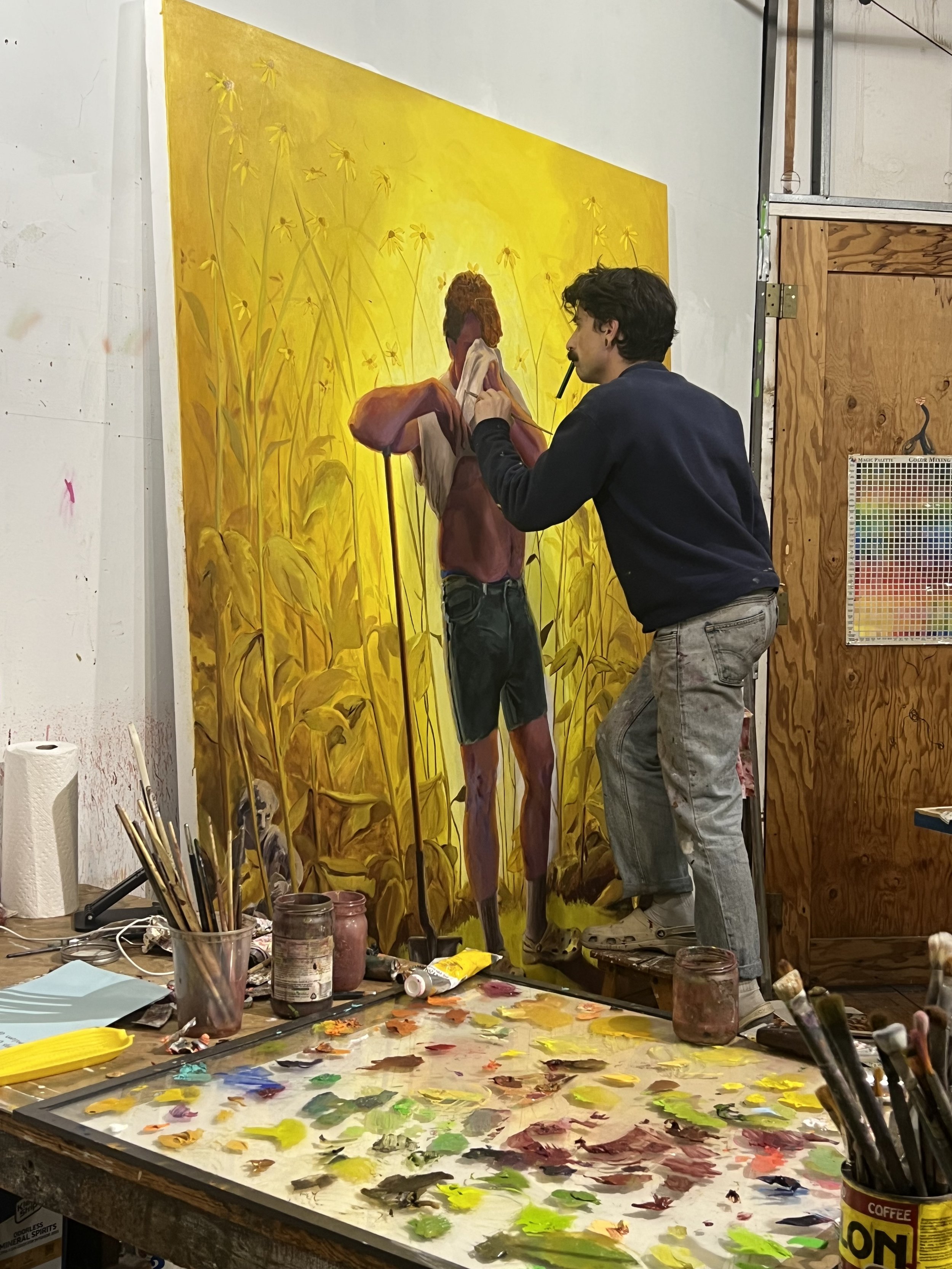
TURK: You said Sweat took far too long to finish. What was going on while you were making it? What was it teaching you?
ARTIM: That painting took just over a year. The painting is of my husband, Mitch. I wanted to make a painting that was very straightforward in celebrating the way you love someone, or fall in love with someone. He's in the garden, he's shoveling something, sweating like a pig, trying to lift his shirt up to wipe the sweat off. And in that moment you can still look at this person and fall in love with them, over and over again. It's almost biblical, the way you feel about this person. That's why there's this giant light beaming from behind him, peeking through all these flowers.
It took so long because I had such a specific way I wanted you to feel the light. The way it hits the skin. The way you have to look through the light to see this person. It wasn't about high contrast. It was about light enveloping this person. I knew I wanted a purple and yellow contrast, but not harsh or abrasive. Soft. Almost like that moment when your eyes are adjusting, and you can still see a lot of the person even though the light is so strong.
TURK: If it took a year and you were seeking that, how did you know you'd met it? Is it a feeling? Is it technical?
ARTIM: It's both. I was painting and repainting that skin so many times. Painting it once and being like, nope, it's too dark. It's too cold. It's too fleshy, it's not fleshy enough. So much of what took so long was color theory, trial and error. It was such a pivotal painting for me, especially for the works that came after it. I was trying to set up my studio in a different way, set up my palette in a different way, to try a new approach. Attack the color in a new way. I'm always trying to find what I call the in. When I get into the studio and start working on a painting, where's the in that's going to let me lock in for the day and really make some moves? Some days I'd come in and just mix color for three hours. Then give it a shot, come back the next day. If it was right, I'd move forward a little more. If it was wrong, I'd wipe it out, or sand it out, and start again.
TURK: Several of your paintings are rooted in a family of one color. Talk to me about color.
ARTIM: Color is so important to me. It's one of the ways I really connect with painting, and one of the things I find most fascinating about it. There's so much to learn, and I want to soak it all up. How the color gets decided varies. Sometimes it's as simple as wanting to make a red painting. Sometimes the color changes and develops as you're making it, and you have to bend to its will. You have to allow that to happen.
There's a small painting of Mitch in a window called A Familiarity, and it truly came from me wanting to make a purple painting. Not a garishly purple painting. A very subdued, mellow purple painting. I like that thought process being as simple as that, because it lets me learn about that color. How to mix different variations of it. More often than not, you learn it's not, oh, I'm always going to take a dioxazine purple, or an Egyptian violet, and mix variations. Sometimes you're mixing three or four colors you had no idea would end up making a purple. And you learn so much about color in the real world, how it functions, how we see it, and how that translates to actually making a painting. Ah, I love it.
TURK: What does that feel like?
ARTIM: It's truly one of the greatest highs you could possibly imagine. When I'm making paintings, I think about color like standing in front of a giant switchboard, with all these knobs you have to keep turning and adjusting to make the levels hit just perfectly. There's value, there's temperature, there's the hue itself. And when you hit all of those just right, it all just beautifully comes together. It's something I'm always really trying to work on and understand. It's not until you're working on it yourself, with your hands, that you're like, I see it, I feel it, I know how it works. It's this beautiful-mind moment. I had a moment like that with one of the paintings for the show, and I truly laughed for so long. I thought I knew something for the last twenty years, and it didn't occur to me until now that I had no idea what the hell I was talking about. But now maybe I know a little bit more.
TURK: There's a note on your studio wall that says BALANCE. What does it mean to you? Why is it up there?
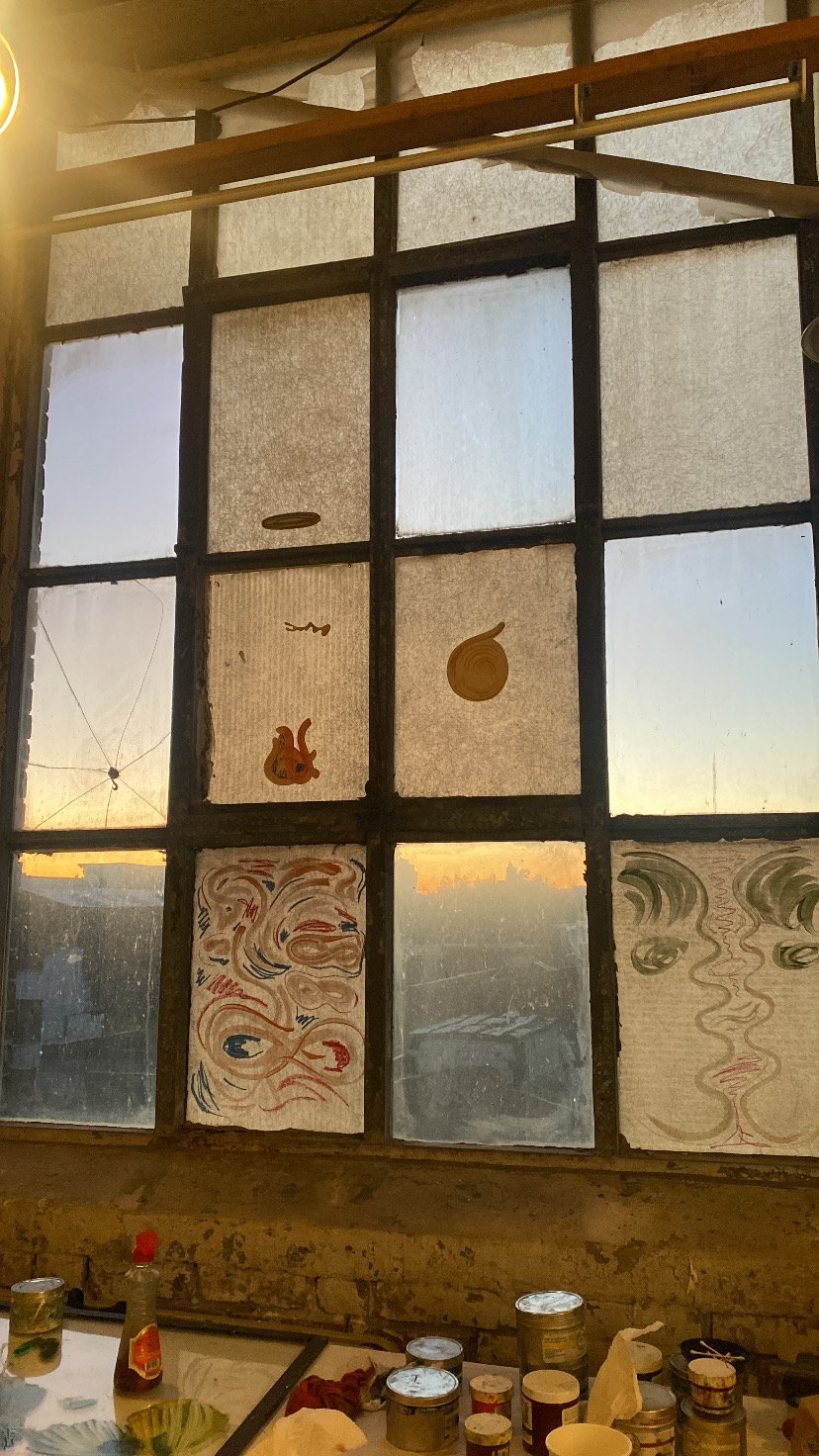
ARTIM: I put that up because for a while I was working on a lot of stuff that had a lot of symmetry. Everything was very well harmonized, very well balanced. So I put it on the wall to remind myself to ask whether that's necessary. The full sign says: Balance. How do you use it? Is it necessary? Do you gain more by throwing the balance off? I have notes like that everywhere. Little reminders. Don't get comfortable. Always ask if what you're doing is the right way to do it.
My studio mate Grace and I say, I could finish this painting tomorrow if I wanted to. All I have to do is put a mark here, a mark there, and it'd be done. But is that the way I want to finish it? Is that the right move for what I want out of this? There are fifty ways to finish a painting. If it's not the way you want to finish it, or the way you think is right for that work, then it's pointless.
TURK: How do you hold on to that? Making it the way you really want to see it, really want to feel it?
ARTIM: For me it really is so much about the paint and the act of painting. I never want to be one of those artists who figures out a formula, and then every piece thereafter follows that formula. I always want to be challenging myself, pushing myself, asking new questions about paint, what it can do, what I can do with it. Testing my abilities. No one's ever going to stop me from being that.
“I can't see myself doing anything else. There was a good chunk of time after I finished Hunter and moved from New York back to Philly where I was in a weird place and couldn't really make anything. But I still made sure I had a studio. I still tried to make stuff, even though it was a bunch of shit for a while. And I realized, if at that point in my life, which was kind of bleak, I was still drawn to this thing, then this is it. This is what you've got to be doing.”
TURK: So much of the conversation around art, especially in the last ten years, is focused on the artist's personal story and the content, not the technical side. The color theory. The painting. Does that get in the way for you?
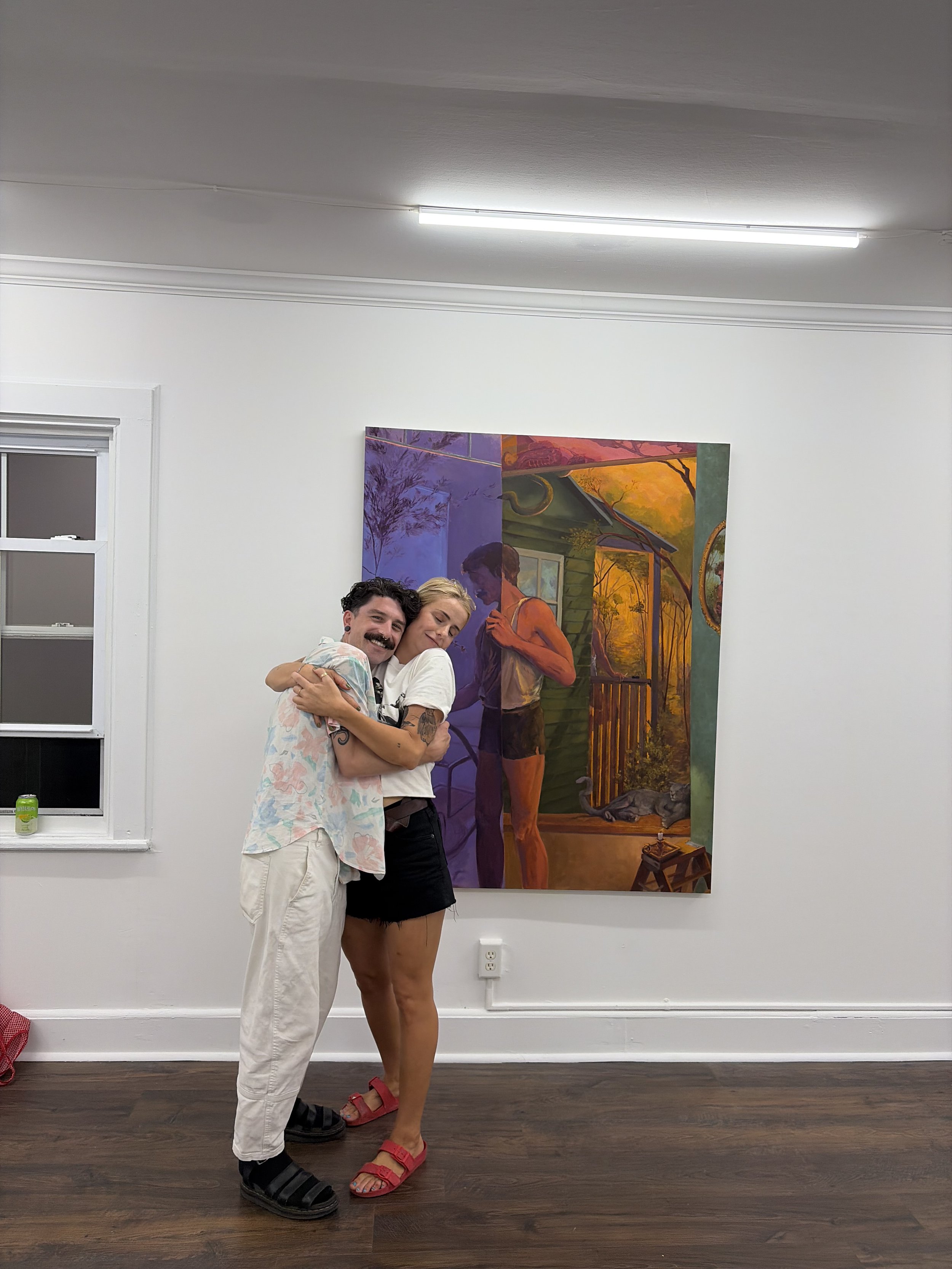
ARTIM: It doesn't get in the way necessarily. If we want to talk concept versus formal, I eventually arrive at the concept through the formal. The color choices I make in a painting are because I'm trying to push a concept or an idea. I want to start by talking about why I chose to make half of a painting purple and the other half predominantly orange, like I did in Rearing Bygones. We can talk about how we got to the concept through the formal. I feel like people just shoot straight to the concept.
TURK: Paint brings me to my knees. The process is what artists really get off on. It's what they do all day, and we skip right past it. But let's talk about content. The garden. Shovels, ladders. It keeps coming up. What is it for you?
ARTIM: I've been working with this garden allegory, metaphor, for a while now. It started with a weird fascination with topiaries. The idea of people trimming bushes to look like objects, or people, or things. It evolved, and the garden became this weird space where I could explore unspoken things. Pulling back to Baroque, Rococo, Renaissance paintings, where we're just going to talk around the thing. I loved that, and I really love symbolic imagery.
Around COVID, I started getting into gardening myself. My husband and I built this massive garden. I only ever planted flowers. It was always just about flowers. I started thinking about how the garden is about all the work you put into it. You're tending to it every single day. You're doing it out of love for the end result, but it's also totally vain. So you can be like, oh my God, look at this garden, look at all these beautiful things I've created. But you also become super attached to all these plants, and you start to understand how to care for each one. I was thinking about it so much in terms of my own relationship with my husband. And in terms of my own life. Trying so hard to grow and be a better person, but having all these outside forces constantly in competition with that. Or your own self, sabotaging this idea of wanting to be better, or be the most beautiful thing you can be.
I've always painted about love and identity, and how I exist within my own queerness. But I think a lot of queer painting right now really hones in on the sexual side of queer identity. And I always thought, yeah, this part is great, and I love looking at it, but let's talk about how hard it is to navigate being in an open relationship. Or feeling self-conscious. There are some things that are tender and really beautiful, and it’s not always hot and horny. There's so much more to it. The garden lets me explore all the ranges of that.
TURK: I love a Doron Langberg painting as much as the next person. But the two of you building a garden at your house, that's something to long for. That's as much about queer identity as sex is. Does your husband like being painted?
ARTIM: It's so funny that you ask this, because I hate admitting it, but I'd actually never asked him. Not until this past year. A friend asked me how does Mitch feel about being your muse in everything? I kind of panicked for a minute. Oh my God, I've never actually asked him. That night I went home and said, I know it's putting the cart before the horse, we've been together fourteen years at this point, but is this okay? Are you okay being the center of all my work? How does it actually feel? And he said, when you first started doing it, I felt really honored. I was so enamored by it. And I still feel honored to this day. But to be honest, I don't think about it as much anymore. I kind of look at myself as a character. He still loves it. There are a few select paintings he really does not like. But for the most part, he's totally on board.
And it's funny, because I use him and myself in almost everything I do, but I actually don't really think about it either. Whenever I'm in a painting, I'm not really seeing it as myself. I'm also looking at it as a character. A vessel, in a way. I was getting ready for this show, I had all the work hung up, and I got a little bit stoned and had this moment. Oh my God. It's just us everywhere. So embarrassing. I cannot show people this. It's this crazy memorial to us. And I started asking myself, why am I not painting other people?
I still don't really have an answer. But I think part of it is that I never really thought much of myself when it came to painting. I'd look at contemporaries of mine, friends, painters, and think, oh my God, they're all so amazing. I could never have that much raw talent. So to ask somebody to be a model for me felt really embarrassing. Who am I to want to paint this person? But you're my partner, so I can ask you. You have to say yes.
Sometimes it's just an overarching feeling I want to convey. Deep, passionate love and admiration for someone. That's such an intangible thing. The way I can tap into that is my own experience. I could probably pick two people who share that kind of passion and paint them. But that's their connection. I'm not a part of it, so I feel a little strange painting it. For me: go to the source. That's the relationship I have with my husband, or the feelings of insecurity I have about myself.
TURK: When you look back at a painting of yourself, or you're in the middle of painting yourself, does it burn away some of the insecurity, or make it worse? How does that object you made, that you're in, help you process?
ARTIM: I don't know if it does. But maybe it's like therapy. Being able to verbalize something knocks it off the pedestal a little. It takes the scariness out of it. I think it does that for me, a little.
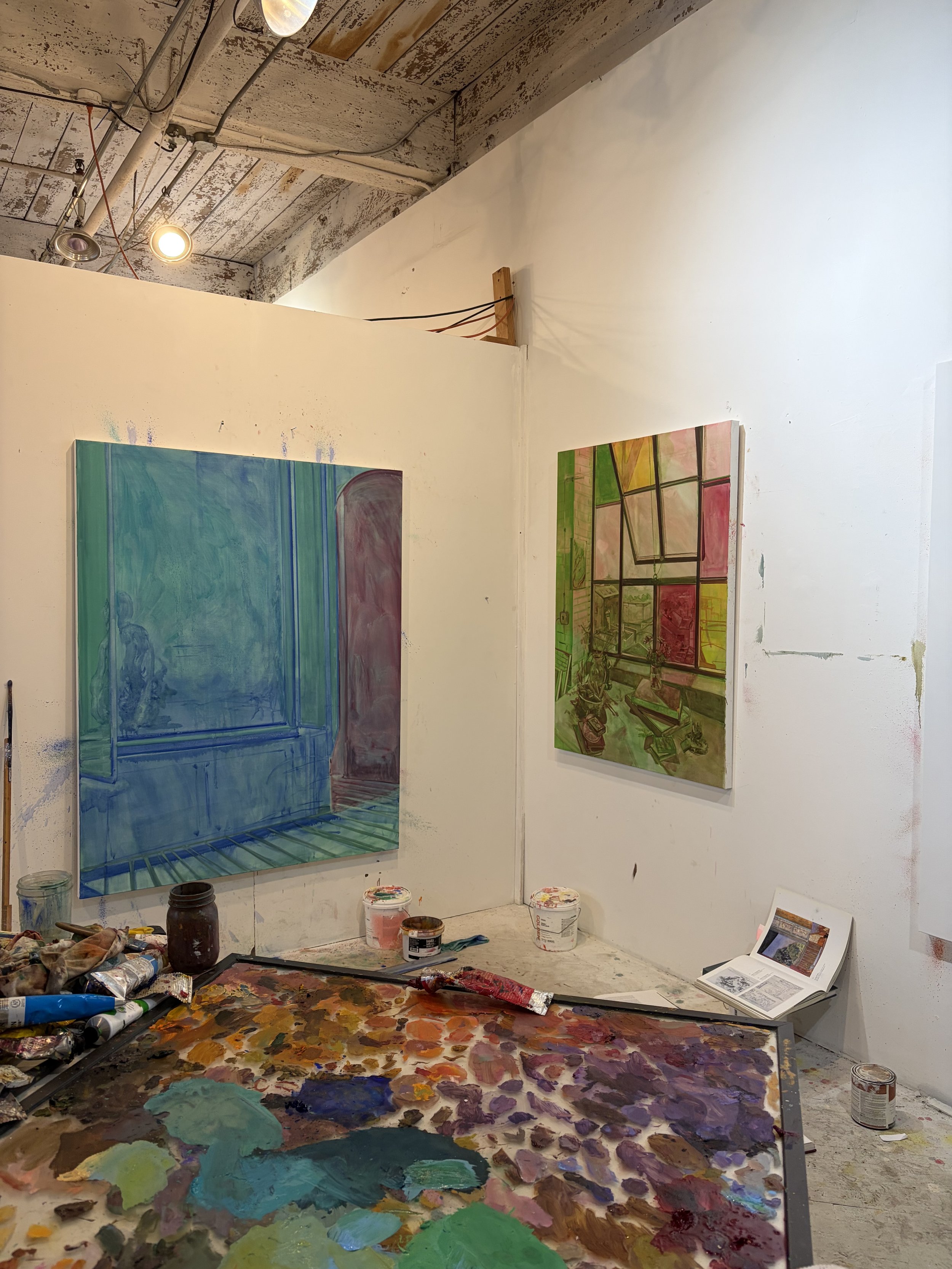
Take the painting I just finished for this show, Rearing Bygones. It's a strange painting. The left side is predominantly purple, kind of looks like a glass door, and you see this figure split between both sides. The purple side, and then this orange side with a cabin-like house, a ledge with a cat, a candle, all this stuff. The whole way that painting developed was based on color and composition. I wanted to split this painting, not halfway, but slightly, kind of diagonal. I started very generally, building slowly, and certain objects started showing up. There's plants, there's a snake in there, there's a cat. All of it coming together, and probably three-quarters of the way through, I'm like, where is all this coming from? Why am I feeling this?
We had a cat we ended up having to put down last year, on my birthday, very unexpectedly. And that cat showed up, and it was really important to me. I must have painted this cat eight times over before the show. Literally the day before, I'm still trying to get it right. It was so important that the cat felt like the cat we had. Her name was Nadine.
I realized I was making this painting because I was thinking a lot about all the things we do in our past that we regret. Bygones be bygones. These mistakes we've made, that we try to move forward in spite of. And yet we continue to make mistakes, over and over. We keep rearing all of these mistakes. Being caught in between. The tension of wanting to foster new and exciting things that aren't fully fleshed out yet, all the stuff behind that hazy purple glass door, while still being incredibly aware of the mistakes we've already made, and the things that have left us. You know you're going to keep making mistakes. It's inevitable. But we have to keep going. Not memorialize the mistakes. Accept them, and be okay with them.
TURK: Not hiding it. Letting it still be there, because it's part of who we are. You seem sure of what kind of painter you are. Where does that come from?
ARTIM: I think a lot of it is that you know you're going to make your best work when you're being your actual self. Painting is such a personal, intimate experience. If you're trying to pretend to be someone else, or make something you think everyone wants to see that isn't authentically you, it's never going to be that good. I want to feel good about what I'm doing. I want to be excited by what I'm doing. And I have to not lie to myself and admit that comes from me. Who I want to be, what I want to see, what I want to do and explore. I'm not going to fight that at all.
TURK: Not everyone has that. The world often pushes against it.
ARTIM: I've been doing it for so long. And it's fun. But it can be one of the most thankless things, because not everybody gets painting. It's not a topic you can bring up at a bar with anybody. So a lot of the time you're doing this alone, by yourself, and no one really understands what a day in the studio feels like. So you've got to keep doing it for you. Otherwise I would have stopped ten years ago.
TURK: Is it lonely for you? And if it is, are you okay with it?
ARTIM: It's so hard, because my gut reaction is no, it's not lonely at all. But as I think about it more, there are some aspects that would equate to loneliness. I'm very happy by myself. I love having a day to paint by myself. So no, that never feels lonely.
What does get lonely is not being able to properly communicate or share the process. The act of painting. All these things I'm thinking about and trying to convert from brain to surface. Wanting so badly to share that crazy whirlwind with people, with friends, and not being able to, unless they're a painter themselves, or an artist in some way. That, to me, feels incredibly lonely. My husband is so supportive. He totally gets that I go to the studio pretty much six days a week and spend six-plus hours in there every day. He knows it's the fabric of my being. But what actually happens in there, those six hours, six days a week? Fourteen years later, he still has a fraction of what that actually is. And there's a part of that that kind of breaks my heart a little bit.
TURK: I know that feeling. You want to give someone something so profound to you, something that's in you, and the language it takes to get there is something you don't share. It isn't hidden on purpose. Is it harder for you to start, or to finish?
ARTIM: Starting can be really daunting. I have a stack of small 16-by-20 canvases in my studio. Over this past year I started getting a bunch of them prepped and ready, and I'd put four up at a time. They were my throwaway things. It doesn't matter if this becomes something, it doesn't matter if it's good, bad, or ugly. This is just to get your hand moving, your brain moving. Set some arbitrary rules. Red painting, green painting, whatever. Get loose, so you don't mess up something you've been working on for a long time. Giving myself that freedom, taking that pressure off, has made starting a lot easier.
I don't think I've ever really struggled with finishing, knowing when it's done. I'm pretty good at that. But there's also, should I have stopped twenty moves ago? Not that this isn't a good version of the ending, but would the ending have been better twenty moves ago, and I'm beating a dead horse a little?
TURK: The show's up now. You've had all this work in the studio, and now it's out in the world. When you saw it at the opening, what did you feel?
ARTIM: It feels great, honestly. This is the first group of work I've made in a long time where I saw it all up and was like, wow, this is really cool. I actually still like this stuff. I can look at all of them and see all the different things I learned while making them, and be so proud of that, which is really rare for me. Usually I'm like, oh my God, this is so embarrassing, yada yada. But I was really excited to see it in a nice, clean space outside the studio. I was excited to talk to people about what I did, and to see people's connections to the work. And coming back to the studio now, with empty walls and a bunch of surfaces, I feel invigorated to keep going. I don't have that weird lull, that weird depression of, oh, I don't know what to do now, it's got to be better. I don't worry about whether it's better or worse. Now I'm thinking, okay, what are the new things I'm going to teach myself?
TURK: Why is this body of work different? What changed?
ARTIM: I don't exactly know. I'm going to be 36 this year, and the last couple of years were a lot of struggle. Trying to regain my footing, my sense of self, feel a little more grounded. And I feel grounded now. I know who I am, and I know the person I want to continue to grow to be. And because that's so linked to painting for me, because my painting self and my outside-world self are the same, it's this excitement of, yeah, we're growing. We're all growing together. The paintings and me. Let's go.
TURK: Is there a roadblock right now? Something you're trying to get around? Or is this body of work the thing on the other side of it?
ARTIM: That was the major roadblock. But it's also trying to sustain it. I can very easily have a couple of bad days in the studio and all of a sudden be like, I'm a terrible draftsman, I don't know how to draw at all. Which will totally devastate things. If a figure's arm needs to move three inches to the right, I'll do everything in my power to change every other part of that painting so I don't have to move the hand I painted really well one time. That is the worst approach ever. You painted it once. It looked good. You can erase it, move it three inches, and paint it just as good again. That's a constant roadblock I have to remind myself about. Don't go back there. Which is why I set up these other things to keep me loose and positive, like the throwaway canvases. To loosen up, or to generate new ideas.
I'm so afraid of getting stale. I don't want to be the painter who does a single figure in the middle of the page. I want to push the complexity an image can have. I want to push the way a viewer's eyes can travel through a work. I'm really trying to think about how that happens, setting up new parameters for myself to explore. Maybe they're not roadblocks. They're cautionary tales I'm very much aware of. I'm not afraid of them yet, but I know they're there.
TURK: How do you keep challenging yourself? How do you keep the excitement, the hope, the faith of it all?
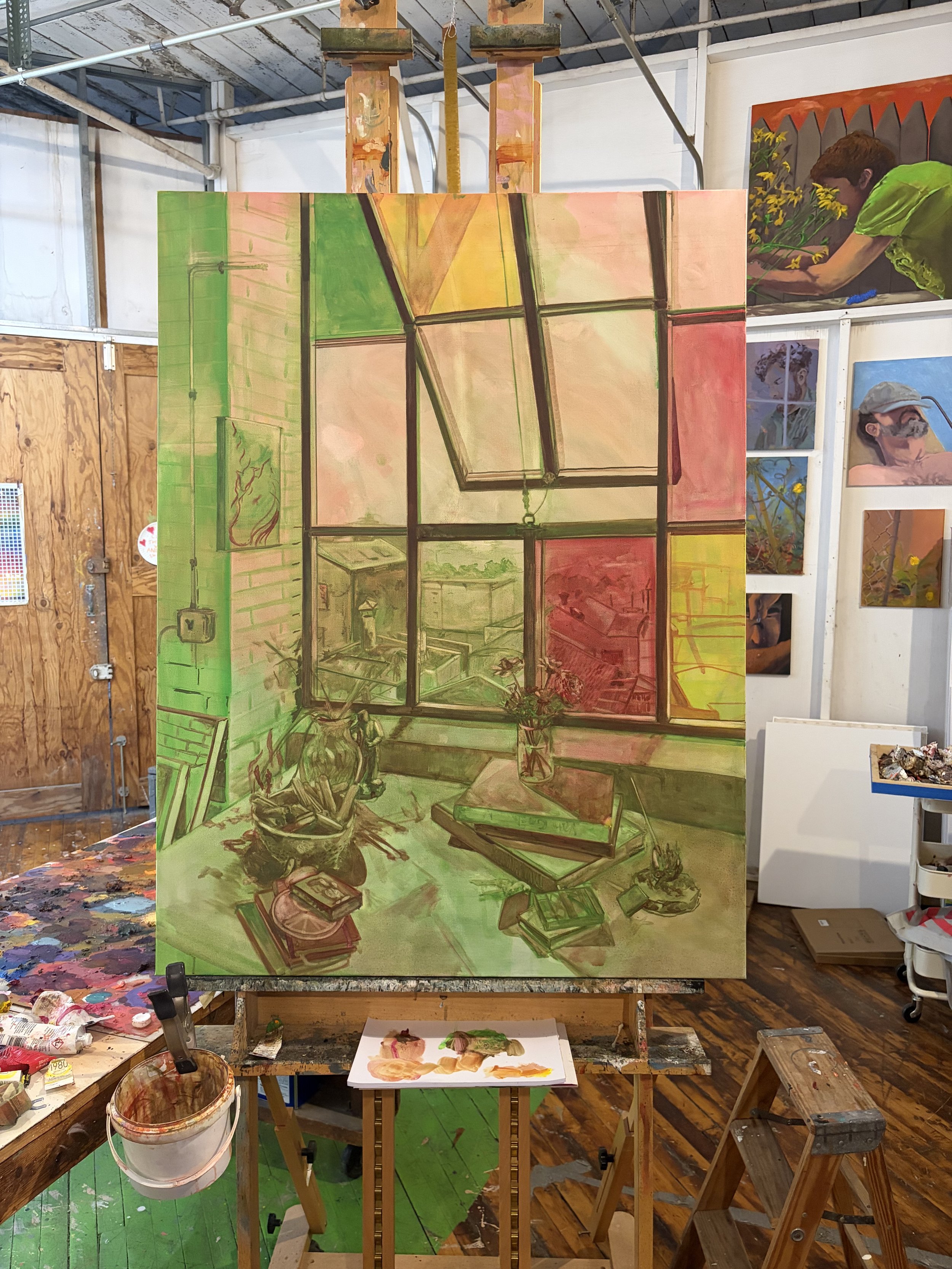
ARTIM: The excitement comes from remembering what paint can do, and what you can learn by doing it. Right now I'm working on a still life from observation. I talk to a friend on the phone at least once a week, usually about painting, and he proposed it. You should make a still life. You haven't made one in a long time. And I'd been thinking so much about old masters, the classic quintessential table still life. Always a weird tilted table with all this stuff on it. So for weeks, the question when we talked on the phone was, well, what's on your table?
TURK: That's a deep psychological experiment.
ARTIM: Exactly. That's what it turned into. Every conversation was, well, what's on the table? And I had a two-week period where I was like, oh my God, there's nothing on my table. There's nothing going on in my life. All I do is go to the studio, come home, and sleep. I took a breather, and then kept going. I started working on this table still life from observation, and it's the simple things that bring me excitement. I spent a full day in the studio, from 10 a.m. until 5 or 6. It must have been later, because the sun started setting. Just working from observation on this big painting. And I was so happy at the end of the day. Oh my God, observational painting is amazing. There's nothing like sitting in front of something and painting it from life. You learn so much. And I truly did. The next day I had to stop and finish another painting for the show, and things were just flowing, because I could take the principles I'd learned from a day of observational painting and start applying them to this painting from imagination. It's the simplest things that really do bring me so much excitement.
As far as the longevity of it, I can't see myself doing anything else. There was a good chunk of time after I finished Hunter and moved from New York back to Philly where I was in a weird place and couldn't really make anything. But I still made sure I had a studio. I still tried to make stuff, even though it was a bunch of shit for a while. And I realized, if at that point in my life, which was kind of bleak, I was still drawn to this thing, then this is it. This is what you've got to be doing. No one pours the amount of money you pour into art supplies just as a might-as-well.