CHANDLER | the interviews
No One’s Gonna Like My House
A Conversation with SIERRA FOX
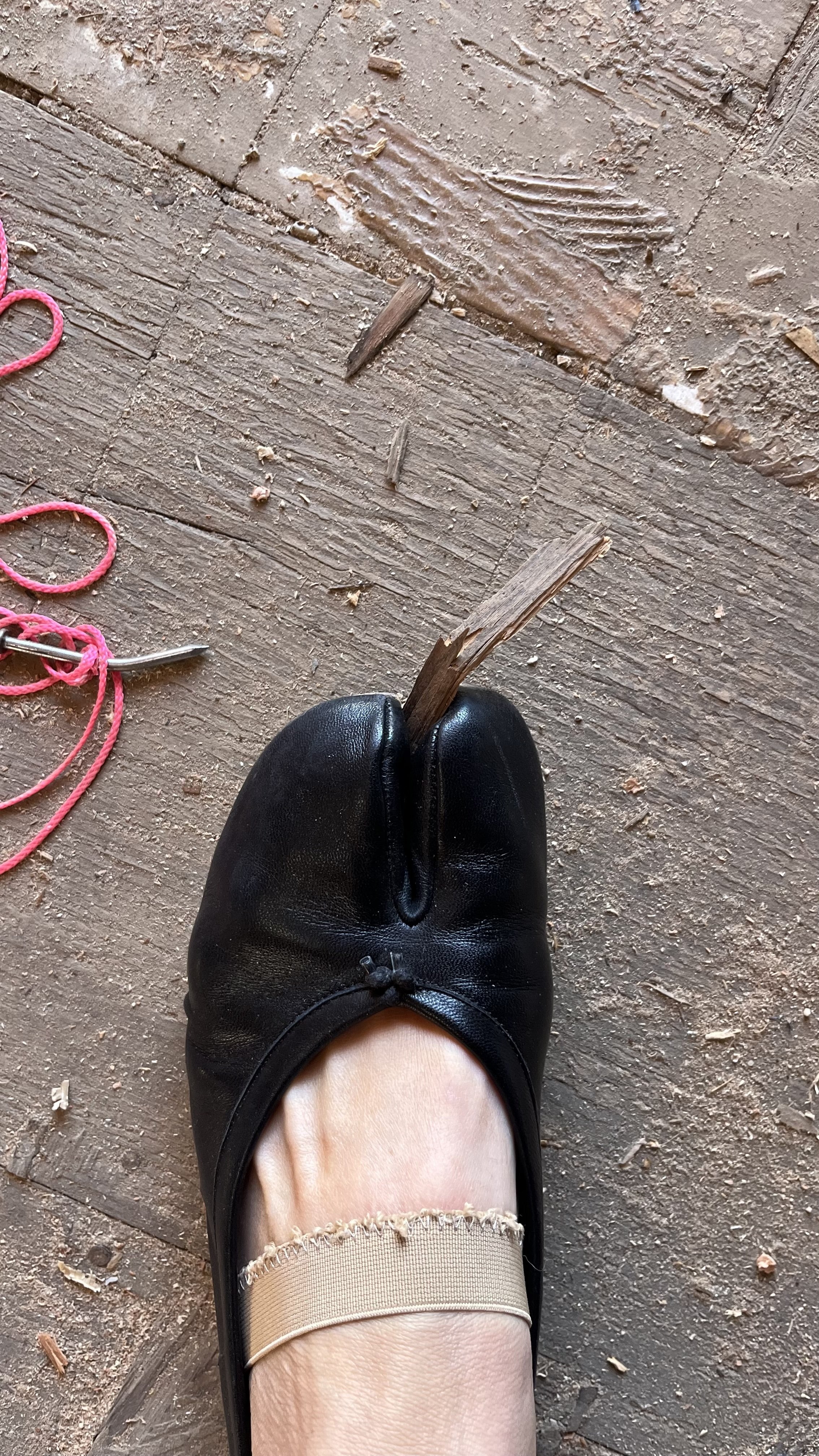
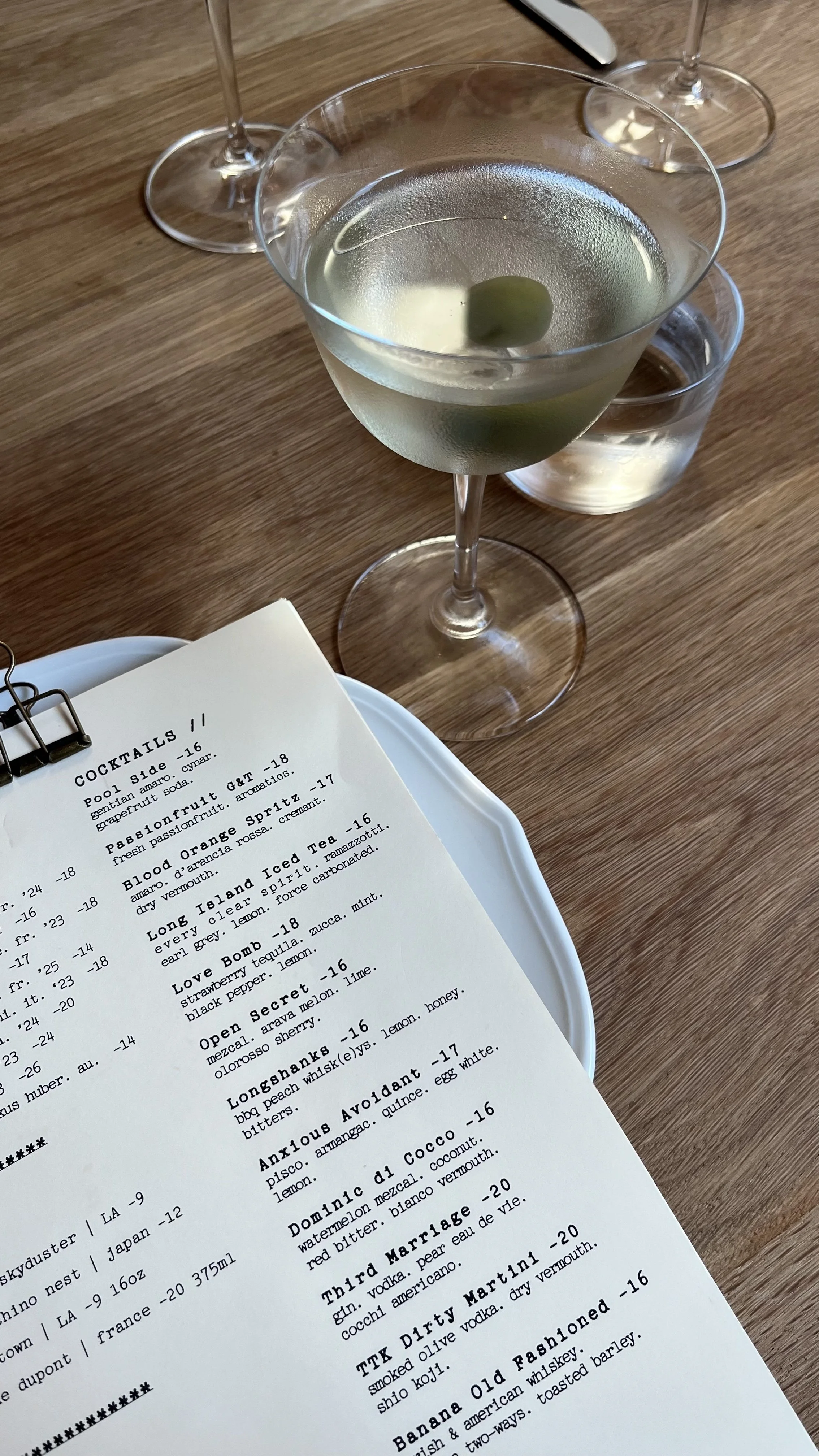
No shoot, no styling, no art direction. I ask everyone I interview for photographs from their own life around the time we talk. Photographs by Sierra Fox.
I found Sierra Fox through a powder bath. On a New York sourcing trip in the fall of 2021 she was touring BDDW, opened a drawer, and saw eighty-two hand-painted amber tiles left over from a larger installation. Feathers, grasses, the West, vistas painted across the baked clay. She and the client looked at each other and no words were needed. They took all eighty-two, then redesigned the first level of the guest house so the powder bath backsplash would fit them exactly. She numbered each one, drew a custom layout for the installers, and prayed nobody dropped any.
The tile presented itself and the house bent around it. That is what I love most about creativity: when someone pushes beyond what has been decided, what’s in the plan, what we all agreed upon, and follows the line of stardust.
Everybody sees the beautiful photo of the finished powder bath. Nobody sees the eighty-two chances that resulted in what we look at.
That’s the conversation I wanted. Not the tile, but what it took to get there. What it costs, and the beauty that makes the cost worth it.
Sierra is the Founder and Principal of Studio MTN, it’s run out of Sun Valley and Los Angeles. Her designs are translations: her vision run through the lens of her client, the place, the architecture. She moves fast, she has opinions, and she knows how to listen to the magic in her blood and when to alter the course to follow it. Entrepreneurship is inherited—there was never a question she’d chart her own path, and do it alongside her family.
In her world there isn’t a line between the work and the life. She is okay with that because it makes her life and her work more rooted in soul and who she is. She’s proud of the blur. I wanted to know what it cost her.
We talked for fifty-two minutes. She had me laughing out of the gate. I was in Austin and she was in Los Angeles. Her voice was raspy and strained on the other end of the phone, a side effect of the birthday party two days earlier.
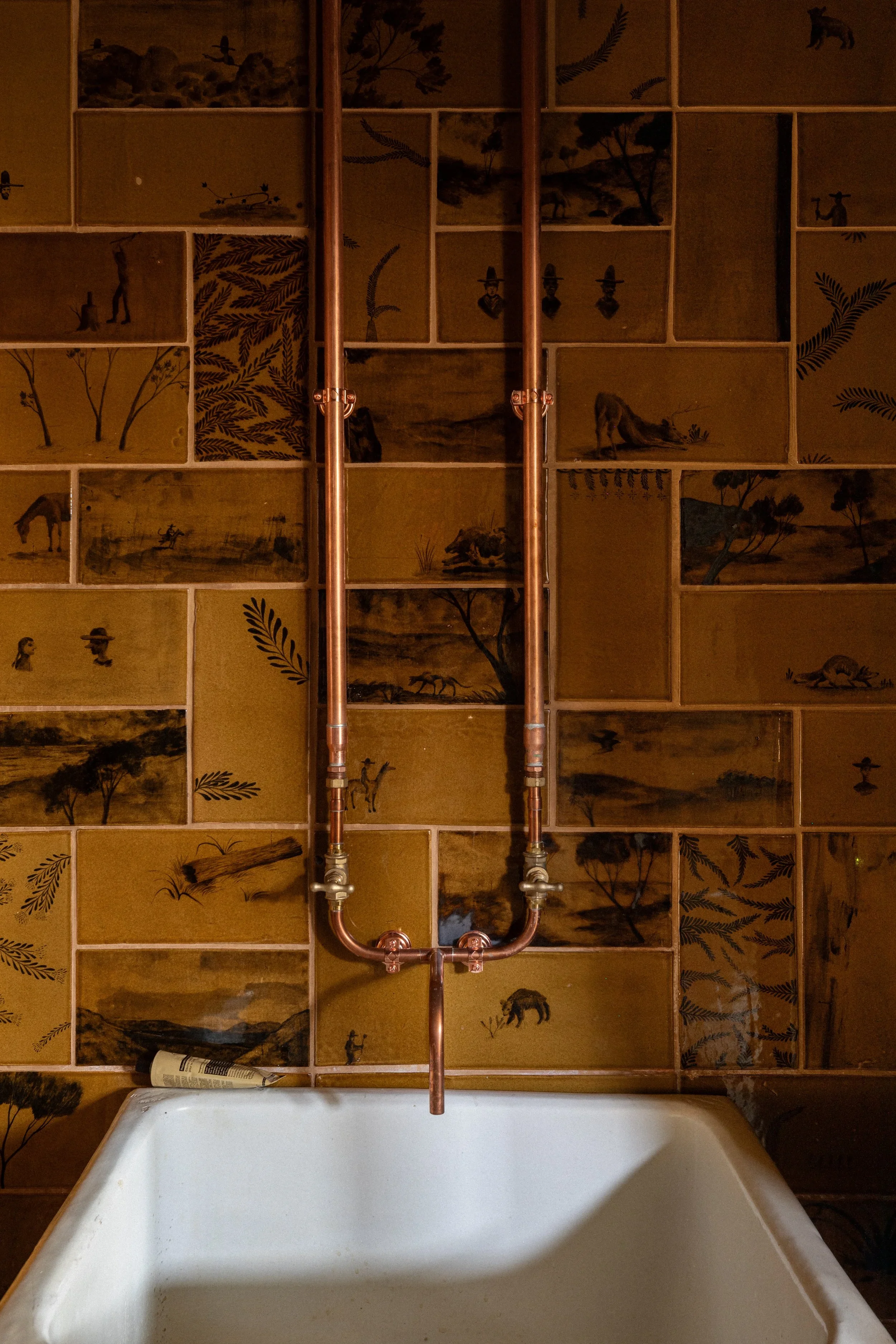
The powder bath, and all eighty-two of them. Tiles by BDDW. Studio MTN; photograph by Aimee Mazzenga.
TURK: Your family seems close, and built on this entrepreneurial spirit that feeds each other’s interests and business. What was it like growing up inside that family; what’s it like to work with them now?
FOX: Both my parents are fairly entrepreneurial. My dad was an entrepreneur my whole life; my mom had her own businesses, ultimately wound up being a full-time mom, and was also a photographer. That molded me and my sister, for better or worse, to always have a business-minded brain on. To normal people, our family can be very insufferable. We’ll be at dinner and my dad’s like, hmm, I wonder how many seats they have here, and if they do two turns in a night—he’s running the numbers on every business he experiences. Some people might say, why are you always complaining about things? And I’m like, there’s just always room to make things better and more efficient.
TURK: How did you end up working together?
FOX: Sort of by accident. My sister was designing handbags, and I’d been doing interior design my whole career. Then she built a house for herself, and she was calling me constantly, asking questions, researching details. When she was about to finish the house, COVID happened, she got freaked out and sold it, made a good amount of money, and called our dad: should we build another one? Do you want to invest? They started building houses together and brought me on to do the design. Every time we finished one: okay, I guess we’re doing it again. All of a sudden you turn around, you’ve done it five times, and you go, we should probably have a business for this. We figured it out as we went. We were building the rocket as we took off.
And working with family is not easy. That’s just the truth of it. It’s really fun, but it’s a funky dynamic when you’ve got three people in a room who all want to be the boss, and we’re all related. My dad called me the other day for my birthday and started talking about work stuff, and then—oh, sorry, sorry. We can’t help ourselves. It’s what we love. It’s just in our blood.
TURK: I get that. There’s this thing in culture about separation between work and life, and I’ve never had it. Is there a line for you? Or have you accepted that it’s blurry, and that’s part of it?
FOX: I have tried. I’ve got a couple of Virgo placements in my chart—not to be too LA. But when you own the business, run it, operate it—it’s your brainchild, your baby, and your name—there isn’t ever a time where I’m not on. I’ve gotten good, out of necessity, at boundaries. The first couple of years I was so excited all the time, all I wanted to do was work, and then a couple years go by and you’re like, I’m actually exhausted. But the way my brain works, how I live day to day? The best I’ve got is a work Instagram and a personal one.
My company is me. I’ve thought about how I’d scale someday. We’re four people, and my business cannot run without me. For business people who scale companies and sell them, that’s your worst nightmare. But the whole point of me being in business is I want to have fun, I want to be doing design. All the parts I love wind up being the parts where I’m needed. I kind of don’t want to change that.
People say, all you ever do is work—because even on weekends I’m at an art show, I’m at a museum. But my work is my passion and my hobby. You could think of it as: all I do is my hobby, and sometimes I have to do invoicing.
TURK: You get paid to do what you like.
FOX: Exactly. I wouldn’t want a job I didn’t like just so I could enjoy my time after work. For whatever reason, design I like doing, and I like doing it for work. I’m on my email all the time.
TURK: Email is the death of life. But it’s where it all anchors.
FOX: Exactly.
TURK: You’re the product. When a client hires you, they’re telling you they want you—and what they’ve seen is work from one, two, three years ago. How do you evolve and keep the brand intact?
FOX: You get really into a project—your whole head and heart is in it—and you fall in love with a certain style, a certain direction. Then you meet a new client with different architecture, a different vision, a different lifestyle, and all of a sudden you’re having a crush on this other aesthetic. What I’ve broken it down to—and I’m still learning how to say this—is: when you see the spectrum of light, it’s white, and then you open it up and it’s all the different colors. I feel like I’m whatever that thing is that can take all the colors and concentrate them back into white light.
It gets trickier when clients have similar taste—a lot of ours are referrals, so they know each other’s houses. If two clients love the same light fixture, instead of repeating it: is there a way to get the same feeling from a different thing? Can that vendor make a side table instead of a chandelier? A bed instead of a chair? I do have a couple of things I’ve repeated, and it just is what it is. Sometimes we say, okay, it’s retired after this one.
TURK: I love that—clients letting you fall into different parts of who you are. Because so much of working with clients is being their therapist. Or their fortune teller: what are they actually saying, what are they aspiring to? How do you take that and embed it into the process, so what you show them at the end isn’t who they were when you started, but who they are now?
FOX: It unfolds. Sometimes there are big pillars that set the tone—an architect with a strong style, horses, young children, a hilly city lot. But most of it you learn over many touch points, organically. It’s like making a new friend. You don’t learn every detail at the first lunch. Sometimes you learn something and go, yeah, that checks out. Other times it’s, wait—what? You went river rafting? I’ve only ever seen you in heels.
It’s the same with clients. We try to see clients in different settings. You learn a lot about someone when you’re in their home—how they interact with the people around them. I tell people when they’re interviewing me: you’re going to get to know your designer really well. I’m going to meet your kids, your family, your staff. I’m going to be in your house, in your room, in your closet, opening your drawers, looking at all of your stuff. It’s a very intimate thing—it’s almost like dating somebody. You’ve got to let them in. The really good projects are the ones where you hang up after the first phone call and go: okay, I’m obsessed with you, and I’d love the job.
TURK: When people interview designers, they ask about the creative process. But you run a business—a complex one. A lot of money, a lot of human beings on both sides, the realities of craftsmen and how long things take. How is Studio MTN shaped by what you want it to feel like to work with you—on the not-pretty stuff?
FOX: The outside perception of this business is glamorous, decorative, fashion-forward. People who aren’t in this world don’t even perceive it as a business, and that can extend to clients. If I can own the whole process, that’s where I thrive.
It’s like an app. On the front, a beautiful, glossy, easy interface. On the back end, all the code, the microchips, the processing power. You don’t need to know how to read code to experience the joys of the app. I like to think of Studio MTN as that interface. Everything the client sees has been filtered through their project—their taste, their budget—and presented so all they have to do is feel what they’re gravitating toward. Then my team does the back-end work. I never want a client on an email with a vendor or a subcontractor. They never pay a vendor directly. They have one person to interface with, and that’s me. If we manage all the moving parts and the client just manages us, they can relax. And then we can relax. As long as we get to work with vendors we know and love and trust, and not some random guy the client found on Yelp.
TURK: What’s the biggest clusterfuck you’ve ever been in, how did you get out, and did anyone know it was happening?
FOX: Oh my god—there’s always a situation happening. We had a project in LA. We interviewed a few contractors for the client including someone we’d worked with before—he was a little scattered but otherwise great. My main comment to the client was that he could be hard to schedule. They wound up choosing him because they knew we had worked with him and felt comfortable.
First up was the kitchen. The developer had used Calacatta marble on the islands and bluish-gray Carrara on the backsplash. So strange. The plan: backsplash comes down, changes to tile, and the islands, the Calacatta gold, stay. We did multiple walkthroughs with the contractor.
Demo day. I get a call from him at three in the afternoon—we’re supposed to be on site at four—and he goes: hey, what was the edge detail on the kitchen countertops? I said, it was a mitered edge, but it’s completely irrelevant. Why are you asking? And he goes: we might have a slight problem. I think there was some confusion with the demo team.
TURK: Oh, Jesus.
FOX: I said, there should be no confusion—you and I walked that site multiple times. And he says: they’ve demoed the kitchen islands. The islands we were keeping. Entirely. The Calacatta gold. So I told him, you’re going to have to call the clients, because we have a meeting with them at four. And he goes: no, I thought you could tell them with me. We went in and told her as a team, and she was eating lunch, and she literally pushed her food away and goes: I’m sick. I’ve lost my appetite.
He wound up paying out of his own pocket to redo the two islands, waterfall edges, six slabs of Calacatta gold—and then the clients killed the rest of the renovation we’d designed. The mistake freaked them out that much. We did everything in our power to do it right, he did everything in his power to do it right, and the demolition team got confused—and he wasn’t standing there, which he should have been. Furious client, destroyed timeline, new material to source. Lose-lose. The lesson: I will never again refer a contractor. Here’s a list of names I’ve heard of. Don’t choose anybody based on me.
And things like that happen all the time. On another project there was one slab left for a master bathroom, and the install group brought it in, dropped it, and cracked it in half. Or another project was built a foot and a half too low, in a flood zone, and that spring the whole crawl space flooded. Pumps on the job site, pumping water out from under the house for two months. And it had somehow passed through the architect, the structural engineer, the permit department, and the builder.
TURK: How do you recover from that? Fourteen years in this business and I still struggle with trusting people I don’t know, even when they come highly recommended. How do you get there?
FOX: A lot of it is experience. When you send something to bid, you can tell how a business operates just from how they answer your questions—how long it takes to get a number, what they say their lead time is, whether you can tour their facility. You develop a spidey sense: I don’t like how this person is acting before we’ve even placed the order. Something’s not right here. And sometimes you miss it.
I’ve had clients push back on paying for someone to be on site—we don’t want to pay someone to babysit. Yeah, but you kind of do. Because if something comes up, you want someone with eyes on it who’s a direct report to me, so I can call and go: whoa, whoa, whoa. Stop everything right now.
There’s a rule I love: it’s never the thing you thought was going to be the problem. It’s always something else, something where you sit down afterward and go, how did we not think of this? And the goal, always, is that the client never sees it. We can almost always solve everything with time, money, and creative thinking. We carry the burden of the problem-solving. That’s the job. And vendors change—someone you know and love retires, you get a new rep. There’s always something.

TURK: There really is. Well, let’s talk about something fun. In those first years you were just loving it. Now, with a lot more authorship over what you take on—what are you excited about? What gets you up in the morning?
FOX: The constant is that I love it. But what feels exciting now is that people approach us with an automatic sense of trust. They’ve followed us, seen our work, seen us published, so the rapport is easy—and the projects are getting more interesting. Not bigger for bigger’s sake. More interesting intellectually. A location we’ve never worked in. Somebody wants to build a bunker. A lot of our early projects were rustic because of the Sun Valley connection, and I’ve worked hard to shift back toward Los Angeles and beyond. We were just brought onto a project with an architect I’d admired from afar for years.
Anyone who owns their own business doesn’t want to be told what to do, and the longer we’re in business, the more freedom of choice we have. And selfishly, a lot of it is the freedom of being my own boss. It’s the best thing in the world. Once you start your own company, you can’t go back. You can’t ever have a boss again.
TURK: No, you can’t. It’s truly the best thing in the world. That brings me to how you live—you design all these houses for all these people. What are you designing for yourself?
FOX: Oh, God. I’m going to call it aspirational sickness. Me and all my designer friends—you get so used to designing for clients that your eye becomes so refined that anything remotely realistic for yourself feels absurd. My friends and family are like: you’re kidding, right? And I’m like, no, this is terrible. It’s number illness: I can’t identify numbers properly for who I am financially.
We just renovated our office, and I could not buy a cheap light switch and put it in my office. The nice switches, the Waterworks faucet. Everybody says, you’ll never get your money out of it. That’s not the point.
So, I have a little gem. I just bought my first house in LA, and I’m going to renovate it at some point. I’ve been saving things for years that feel really good to me. Sometimes I get in my head about it: if I renovate this house and it gets any publicity, people are going to go, oh, I don’t like her style—because this is what she put in her own house. But my house and my vision are very different from what I do for clients. I see all this stuff, all the time. When I’m in my house, I want to see literally nothing. I’m already drawn to texture and materiality more than pattern and bold color, but I really want the interiors of my house to just disappear. A clean slate. A fresh palette, so I can paint with the colors my clients need—not mine. Because I love everything. Well, I love a lot, I should say. Super clean, super minimalist, still really earthy, grounded. I want to walk into my house and have my mind turn off, and then go to work and turn it back on.
TURK: I had clients—we did their house, and then they had a vacation home in Aspen, that whole social scene of everyone showing off their houses. I was helping them with their art and they said, well, we know that’s what you like. And I said: no, that’s what I like for you. My house is nothing like that.
FOX: That happens! One of our clients came on a tour of a development project we’d just finished, and she goes, whoa—I can see how this is similar to my house, but it’s so different, and it’s crazy that you did both. It’s like sailing a ship. If you change your course by one degree, you end up somewhere very different.
TURK: I love that.
FOX: There are designers where all the work starts to feel really similar to itself—and that works, that’s also a business. And then there are the really, really good ones, where no matter what the architectural style is, you can look at a project and go: yeah, they did that. The identity is always there, but you get to flex it in ways that feel new. But my house? No one’s gonna like my house.
TURK: Where did you buy?
FOX: Venice. I’ve lived there for the bulk of my time in LA. I’ve always been drawn to it. It just feels very me.
At the end of the conversation, Sierra turned the interview around and started asking the questions. Somewhere in there she said the thing that explains, better than I have, why CHANDLER exists.
FOX: I’ve found so much of traditional PR to be unthoughtful. There are no publications interviewing—and interviewing well—the people we haven’t already heard from a hundred times. Everyone whose name we all know: they’re beautiful, they have incredible houses, they have a ton of money, so they’re doing cool shit. I get it. But there are really interesting smaller firms doing really cool and creative work—probably because they don’t have those big budgets, and they’re really grinding. They’re not getting any attention. But they’re still worth being interviewed, and shared. I think people want to hear from people that are in it, and are passionate about it—instead of some random writer under some editor doing the bare minimum, asking, what’s your favorite paint color?
You may also enjoy
Walter De Maria’s Lightning Field